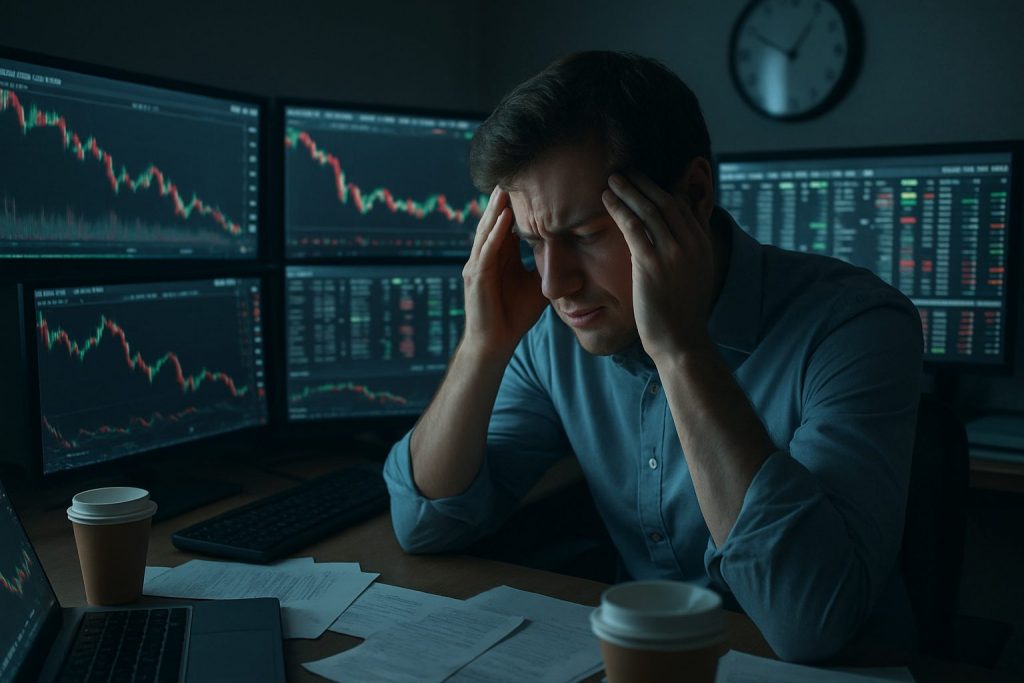
Can day trading cause anxiety? Yes — day trading can cause anxiety and stress because the rapid pace and uncertainty of financial markets put heavy emotional pressure on traders.
Day trading can trigger intense feelings: rapid decision-making, visible profit-and-loss swings, and constant exposure to market noise combine to create a high-stakes environment that affects mental health and trader well-being. This piece examines how the emotional impact of short-term trading shows up, why certain personalities are more vulnerable, and which practical changes to risk management and daily routines lower the burden of stress. Case examples and a fictional trader’s arc illustrate common patterns — unrealistic expectations, lack of self-trust, no clear edge, and impulsive behavior — and present actionable steps to recover balance. Links to additional readings and tools support deeper study; one recommended primer on whether day trading is stressful appears here: https://tradingpriceactiononfutures.com/is-day-trading-stressful/. Expect clear lists, quick tables, and simple routines that help transform anxiety into disciplined performance and sustainable investment strategies.
Can day trading cause anxiety? Key causes in the financial markets
Day trading often creates anxiety because the market environment forces quick, repeated choices under uncertainty. Traders face volatility, social comparison, and pressure to perform — each a trigger for heightened stress.
- Unrealistic expectations: believing quick riches are normal.
- Lack of self-trust: relying on external signals rather than a tested plan.
- No edge: trading without verified probabilities.
- Impulsivity and overtrading: dopamine-driven behavior that mimics addiction.
| Trigger | Typical effect on trader | Practical fix |
|---|---|---|
| Unrealistic expectations | Chronic disappointment, excessive risk | Set realistic timeframes; follow mentors critically; read case studies like this review |
| Lack of self-trust | Decision paralysis, second-guessing | Create a tested trading plan and a small live sample size |
| No edge | Gambling-like behavior | Backtest strategies; track a dataset to quantify probabilities |
Insight: most trading anxiety originates from the gap between expectations and a measurable edge — close that gap to reduce stress.
Emotional impact and trading psychology
Trading psychology explains how the brain interprets gains and losses. Loss aversion and time pressure skew perception and increase the chance of impulsive decisions.
- Loss aversion: losses feel larger than equivalent gains.
- Performance theatre: social media amplifies FOMO and imposter feelings.
- Time pressure: rapid markets degrade deliberative thinking.
| Psychological mechanism | Manifestation while trading | Coping tactic |
|---|---|---|
| Loss aversion | Holding losers, cutting winners early | Predefine stop-loss and profit targets; journal outcomes |
| FOMO | Chasing entries after seeing others’ wins | Limit social media during trading hours; set trade alerts |
Insight: reshaping how outcomes are framed — from moral judgment to probabilistic feedback — reduces emotional reactivity.
Practical risk management to reduce day trading anxiety
Risk management is the primary tool for lowering stress: define what is unacceptable, then make every trade consistent with that boundary. This produces calm, predictable exposure even when outcomes are uncertain.
- Position sizing: risk a fixed small percentage per trade (e.g., 1% of equity).
- Stops and limits: always place stop-loss orders before entry.
- Daily loss cutoffs: stop trading if a preset loss threshold is reached.
| Risk rule | Why it reduces stress | How to implement |
|---|---|---|
| Fixed % risk per trade | Controls account drawdown | Calculate risk using ATR or technical levels |
| Predefined daily loss | Prevents emotional revenge trading | Set alerts and disable trading platform if reached |
Insight: disciplined risk rules replace fear with a predictable, manageable framework that protects mental health and capital.
Biology, habituation, and trader well-being
Biology matters: the amygdala responds to threats faster than the frontal cortex can reason. Repeated exposure with planned boundaries builds habituation and restores executive control.
- Habituation: deliberately face controlled stresses to reduce reactivity.
- Sleep and exercise: foundational routines that lower cortisol and sharpen the frontal cortex.
- Scheduled monitoring: check trades at set intervals to avoid hypervigilance.
| Biological factor | Trading symptom | Practical adjustment |
|---|---|---|
| Amygdala-driven fear | Heart palpitations, urgent exits | Breathing exercises; PMR audio resources; practice sessions |
| Sleep deprivation | Poor decision-making, impulsivity | Set strict sleep routine and limit screens pre-bed |
Insight: small, consistent lifestyle changes and exposure strategies strengthen the brain’s deliberative systems and lower trading stress.
Resources, routines and when to seek help for trading anxiety
Support includes mental-health professionals, trading psychologists, and structured resources that focus on performance rather than moralizing outcomes. If symptoms persist beyond two weeks and affect daily life, professional help is important.
- Structured routines: fixed pre-trade checklist and post-trade review.
- External support: mentor, trading coach, or therapist specializing in performance anxiety.
- Educational resources: studies and articles that set realistic expectations (see https://tradingpriceactiononfutures.com/is-day-trading-stressful/).
| Resource | Use | Where to find |
|---|---|---|
| Progressive muscle relaxation | Short practice to reduce acute stress | Guided audio by performance psychologists; see professional pages and articles |
| Trading journal | Identify patterns and reduce emotional trades | Spreadsheet or dedicated app; review weekly |
| Peer group | Reduce isolation and normalize setbacks | Reputable forums and mentor circles (avoid hype-driven feed) |
More reading: repeated, structured review of market behavior eases the shock of volatility — for a practical look, see https://tradingpriceactiononfutures.com/is-day-trading-stressful/. Practical checklists and mentor-led backtesting are essential for building confidence; a further overview is available here: https://tradingpriceactiononfutures.com/is-day-trading-stressful/. For daily habit formation and small-sample testing, consult this guide: https://tradingpriceactiononfutures.com/is-day-trading-stressful/.
Insight: combine structured practice, professional support, and measured exposure to convert anxiety into disciplined performance; when symptoms are persistent, consult a clinician.
Frequently asked questions
How quickly can day trading anxiety improve with changes?
Improvements can appear in weeks if risk rules and monitoring routines are implemented consistently; sustained changes to sleep and habit formation take several months to fully stabilize emotional responses.
When should a trader seek professional mental health help?
If anxiety or low mood persists daily for more than two weeks or causes physical symptoms (palpitations, migraines) or dysfunction in other areas of life, a medical or mental health professional should be consulted.
Can risk management fully remove anxiety from day trading?
Risk management dramatically reduces the intensity of stress by limiting losses, but it does not erase the normal emotional response to uncertainty; habit training and psychological techniques complement good risk practices.
What immediate steps reduce acute trading stress?
Use breathing or progressive muscle relaxation, step away from screens, enforce a daily loss cutoff, and review one simple checklist entry before any further trades to prevent reactive decisions.
Where to learn more about whether day trading is stressful?
Start with disciplined resources and articles that critique hype; a practical primer is available at https://tradingpriceactiononfutures.com/is-day-trading-stressful/, and seek mentors who emphasize process over performance.

With over a decade of experience navigating global financial markets, I specialize in identifying trends and managing risk as a professional trader. My passion for economics drives my daily commitment to staying ahead in this fast-paced industry. Outside of the markets, I enjoy exploring technology like cryptocurrencies and new investment strategies.