
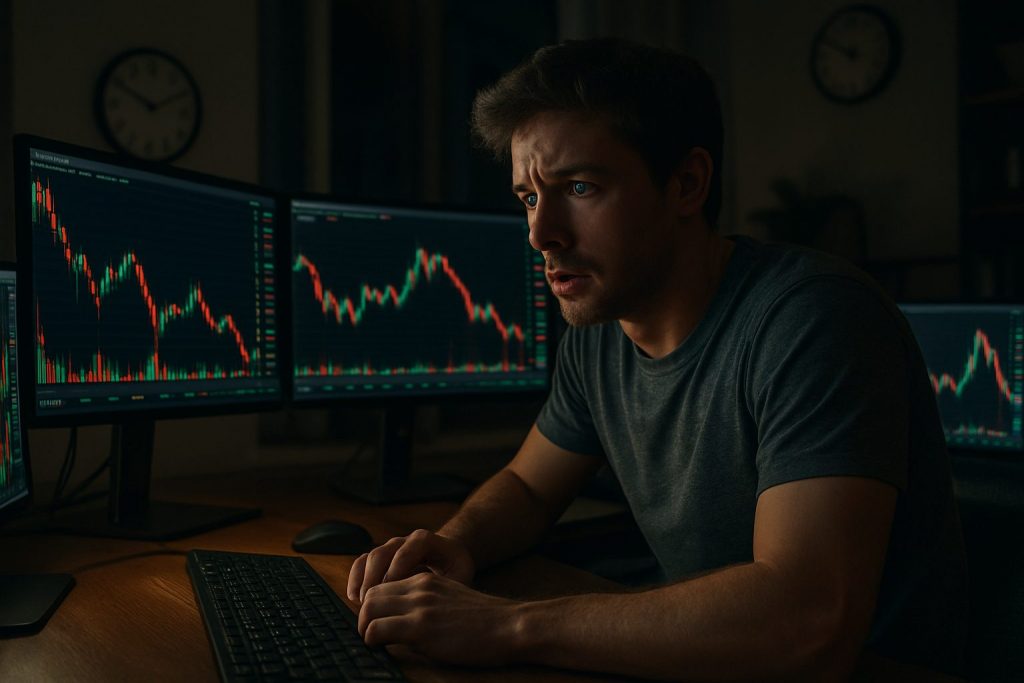
Why do beginners trade without stop losses? Because many beginners let emotions like fear of missing out and overconfidence plus limited experience override simple risk management and trade discipline.
New traders often enter the market hungry for quick wins and visible momentum, unaware that missing a few winning setups can feel worse than cutting a losing position. That emotional math—preferring the possibility of a big gain to the certainty of a small controlled loss—explains much of the behavior observed across beginner accounts. Limited experience with leveraged positions and an incomplete grasp of stop-loss mechanics combine with anxiety, optimism bias, and poor trade planning. The result is repetitive patterns: trades left open through volatility, averaging down instead of accepting a defined loss, and late panic exits that amplify damage. Practical change requires simple rules, repeated practice, and tools that enforce risk management without relying purely on willpower. Not for US residents.
Why beginners trade without stop losses: psychological drivers in trading
Psychology sits at the center of why many beginners avoid stop losses. Emotional impulses and cognitive biases create the illusion that manual control will outperform a preset exit.
Common emotional causes
- Fear of missing out (FOMO): chasing a move and resisting a preset exit in case the market “surges”.
- Overconfidence: belief that intuition or a hunch can prevent losses.
- Denial and hope: waiting for a reversal instead of accepting a loss.
- Lack of experience: poor understanding of leverage and volatility.
- Poor trade discipline: skipping routine rules for sizing and exits.
| Psychological factor | Typical behavior | Immediate risk |
|---|---|---|
| Fear of missing out | Moves stops wider or removes them | Missed small losses, later large drawdowns |
| Overconfidence | Excessive position size, no stop | Account vulnerability to volatility |
| Denial / hope | Hold through adverse moves | Emotional exits at worst price |
Example: a beginner opens a leveraged forex position and removes a stop to “let it run”; after a news spike the trade reverses and a forced liquidation occurs. This scenario illustrates how emotions convert manageable losses into account-threatening events. Key insight: emotions often turn small risks into catastrophic outcomes.
How experience and risk management change stop-loss use for beginners
Experience reshapes behavior: time in the markets teaches that a disciplined stop-loss preserves capital and enables compounding. The transition from impulsive trades to systematic risk rules is a hallmark of growth.
Practical lessons that shift behavior
- Learning position sizing to make a predefined loss tolerable.
- Using routine trade journaling to expose emotional mistakes.
- Adopting simple mechanical rules for stop placement (technical levels, ATR-based stops).
- Testing mental stops vs. actual stops in demo before applying live.
| Stage | Typical change | Concrete action |
|---|---|---|
| Beginner | Avoids stops, trades large size | Start a risk-per-trade rule (e.g., 1% of account) |
| Developing | Implements stops but moves them emotionally | Use fixed rules (ATR multiples), keep trade journal |
| Experienced | Relies on systematic exits and sizing | Automate stops, review edge and expectancy |
For hands-on resources, beginners often ask about leverage and real outcome expectations; reading scenarios on realistic earnings and leverage helps ground emotions. See practical guides on leverage and earnings here: how much leverage with $500, potential with $25,000, and potential with $100,000. These examples anchor expectations and improve trade discipline.
Insight: steady experience + clear risk management rules reduce emotional interference and make stop-loss use automatic rather than optional.
Alternatives to trading without stop losses and practical steps for beginners
Not using a stop loss can be managed only by robust alternative measures—and those require discipline. Traders who skip fixed stops typically rely on substitutes that must be respected as rules.
Alternative risk controls
- Position sizing: use tiny sizes so a wide market swing does not wipe the account.
- Hedging: open offsetting positions to reduce directional exposure.
- Trailing stops / alerts: dynamic exits that follow momentum without rigid levels.
- Manual stop discipline: predefined mental stop enforced by strict rules and journaling.
- Platform tools: choose a platform that supports fast execution and negative balance protection—examples include Pocket Option, Quotex, and Olymp Trade for non-US residents.
| Strategy | Benefit | Limit / requirement |
|---|---|---|
| Position sizing | Limits dollar risk per trade | Discipline to stick to small sizes |
| Hedging | Reduces net exposure | Complex, requires correlation knowledge |
| Trailing stops | Locks profit, adapts to volatility | Can be whipsawed in noisy markets |
Concrete practice steps for beginners:
- Set a clear risk management rule: e.g., risk 0.5–1% per trade and calculate position size accordingly. See related discussion on risk per trade: do beginners risk too much per trade?
- Use demo accounts to test stop rules and alternate exits before live capital—find demos on Pocket Option, Quotex, or Olymp Trade.
- Keep a trade journal that records emotions, reasons for entry/exit, and whether a stop was used.
- Avoid borrowing to trade; borrowed funds increase emotional pressure—see guidance on borrowed money: can I start day trading with borrowed money?
- Control trade frequency to prevent overtrading—learn why beginners trade too often: why do beginners trade too often?
Insight: trading without stop losses is feasible only when replaced by strict, enforceable controls; otherwise, it becomes a gamble that exploits luck rather than edge.
FAQ
Are stop losses always necessary for beginners?
Stop losses are the simplest, most reliable way to enforce risk management. Beginners can trade without them only if they adopt strict position sizing, hedging, or automated alerts, but that requires discipline and experience.
Can trading without stop losses ever be profitable?
Yes in rare cases, but profit is unstable. The approach increases the chance of large drawdowns and emotional mistakes. Structured alternatives and clear rules are essential for consistent results.
How can beginners learn to use stops without getting stopped out too often?
Combine technical placement (support/resistance, ATR-based stops) with proper position sizing and backtesting. Practicing on demo accounts and reviewing a trade journal reduces premature stop-outs over time.
Does platform choice matter for trading without stop losses?
Platform features like fast execution, negative balance protection, and flexible order types help manage risk; for non-US residents, options include Pocket Option, Quotex, and Olymp Trade, which provide demo modes and various exit tools.
What is the first habit a beginner should adopt?
Adopt a fixed risk per trade (e.g., 0.5–1%) and enforce it with position sizing. This single rule protects capital and forces trade discipline, preventing small mistakes from becoming catastrophic losses.

With over a decade of experience navigating global financial markets, I specialize in identifying trends and managing risk as a professional trader. My passion for economics drives my daily commitment to staying ahead in this fast-paced industry. Outside of the markets, I enjoy exploring technology like cryptocurrencies and new investment strategies.