
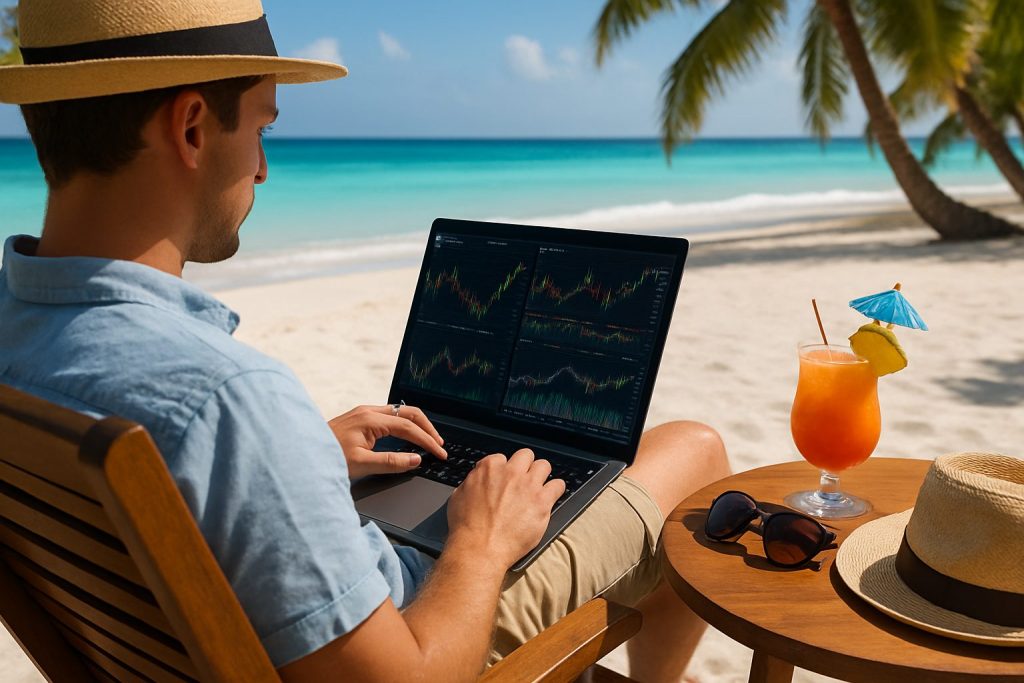
Can I day trade while on vacation? Yes — day trading while on vacation is possible with careful planning, reliable internet connectivity, and strict risk management.
Trading from the road is technically feasible today, but it demands a disciplined plan before departure and rules that protect both capital and the trip. Vacation trading changes the rhythm: markets often thin out in popular holiday months like August, magnifying gaps and slippage. That reality means the most robust approach is to perform a pre-vacation audit, set automated stop-losses and alerts, and decide whether to trade actively or shift to remote trading with reduced risk. Not intended for US residents. A hypothetical traveling trader — call him Marco — tests these ideas: he closes speculative positions that lack clear stop levels, automates routine scans with mobile trading apps, and limits check-ins to fixed windows to preserve focus and joy. The result is a portfolio that can survive short absences and a vacation that actually feels like one. Below are actionable sections on connectivity, automation, emergency protocols, and tactical trading strategies for those who choose to trade while away.
Day trading while on vacation: practical considerations for remote trading
Before booking a ticket, evaluate how vacation trading will change execution and risk. Time zones and reduced liquidity can create scenarios where a plan crafted at home behaves differently abroad.
- Assess market liquidity during your travel dates — thin markets increase volatility.
- Map time zones so trade hours align with personal energy and local activities.
- Decide whether to go fully automated, partially active, or cash out.
| Factor | Impact on vacation trading |
|---|---|
| Time zones | Shifted trading hours, fatigue risk |
| Internet connectivity | Execution lag and data delays |
| Market liquidity | Wider spreads, higher slippage |
Marco frequently checks three things before traveling: trade thesis integrity, stop placement, and earnings or macro events during the trip. This small audit prevents reactive trading from vacation distractions and serves as the emotional firewall between sightseeing and performance.
How to prepare: pre-vacation audit, stops, and automation for day trading
A rigorous pre-vacation audit turns vague worries into concrete actions. Set rules that execute without emotion, and let automation run the repetitive tasks.
- Run an audit: confirm the trade thesis for each position; close or reduce any position without a clear plan.
- Place hard stop-loss and profit targets before departure.
- Enable automated alerts and scanning criteria in mobile trading apps to filter noise.
| Step | Purpose |
|---|---|
| Audit positions | Remove emotional holds and unknown risks |
| Set hard stops | Limit downside during absence |
| Automate scans/alerts | Receive only actionable signals |
Automation is not abdication. When properly configured it enforces pre-defined trading strategies while the traveler enjoys the trip. Traders who rely on automation return more rested and often with healthier accounts.
Remote trading logistics: internet connectivity, mobile trading apps and time zones
Reliable connectivity and the right mobile tools are the backbone of successful vacation trading. Poor connections create execution uncertainty; good tools reduce it.
- Carry a primary and backup internet plan (local SIM, portable hotspot, hotel ethernet).
- Use mobile trading apps from trusted platforms like Pocket Option, Quotex, or Olymp Trade.
- Plan check-ins around market opens/closes adjusted for time zones to avoid fatigue.
| Tool | Why it matters |
|---|---|
| Local SIM / eSIM | Primary low-latency data source |
| Portable hotspot | Backup when hotel Wi‑Fi fails |
| Broker mobile app | Order entry, alerts, quick adjustments |
Final insight: test all connectivity and the broker app in the destination before relying on them. A single dry run clarifies whether remote trading is realistic for that trip.
Risk management and emergency protocol: trading strategies to protect the trip
Trading while vacationing is a stress test for any system. Define emergency triggers and decide upfront which positions truly require intervention.
- Create an emergency protocol that outlines who acts and when (self or trusted contact) and how to act.
- Use smaller position sizes and wider stop spacing to accommodate thin markets.
- Consider switching to swing or position trades if day trading distractions will be high.
| Scenario | Action |
|---|---|
| Stop hit | Automatic execution — no check-in required |
| Major macro event | 15-minute focused assessment, then decision |
| Connectivity loss | Pre-set OCO orders or accept the risk |
Insight: the best emergency protocol is simple, rehearsed, and minimizes emotional decisions. A clear rule beats panic every time.
Resources and reading for career and financial planning around trading
Vacation planning ties into broader questions about trading as a career and financial goals. These resources explore sustainability and whether trading can replace regular income.
- Can day trading be a full-time job? Read perspectives here: Can day trading be a full-time job?
- Questions on living from day trading profits: Can you live only from day trading profits?
- Long-term career considerations: Is day trading a sustainable career long-term?
- Financial freedom and trading: Can day trading provide financial freedom?
- Part-time and student options: Can day trading be done part-time while working?
| Question | Suggested starting point |
|---|---|
| Replace regular job? | See analysis |
| Make a living? | Explore case studies |
| Early retirement? | Read considerations |
Key takeaway: vacation trading decisions should align with broader financial planning and career goals; treat a trip as a test of systems, not a one-off gamble.
Final practical checklist before leaving
- Complete the pre-vacation audit for all open positions.
- Set hard stops, profit targets, and price alerts in the mobile trading app.
- Confirm primary and backup internet connectivity at destination.
- Define a strict check-in schedule and an emergency protocol.
- Decide which broker platform (Pocket Option, Quotex, Olymp Trade) will be used and test it live.
| Item | Done? |
|---|---|
| Audit positions | No / Yes |
| Stops set | No / Yes |
| Connectivity backup | No / Yes |
Useful multimedia and community embeds
Watch practical guides and community tips before the trip to refine the routine and technical setup.
Community discussions help refine time zone handling and trading strategies for vacation environments.
Key insight: day trading while on vacation is achievable, but only when preparation, risk management, and technology are aligned to protect both capital and the quality of the trip.
Questions traders often ask
Can day trading be done safely while traveling? Yes — with a pre-departure audit, set stops, automation, and tested mobile trading apps, remote trading can be managed safely for short periods.
How often should a trader check positions on vacation? Establish a fixed check-in schedule (for example, once in the morning and once after market close) and stick to it unless a pre-set alert forces action.
Which brokers are good for mobile vacation trading? For remote trading, reputable mobile platforms like Pocket Option, Quotex, and Olymp Trade offer portable apps, but always test execution and connectivity at the destination.
Is vacation trading mentally sustainable? Trading while distracted often leads to worse outcomes; if the trip’s purpose is rest, consider cashing out, shifting to swing trades, or using automation to preserve both well-being and capital.
What if internet fails mid-trip? Pre-set orders and backup connectivity plans (local SIM, hotspot) mitigate many risks. If these are not available, accept the risk and avoid active trading until connectivity is restored.

With over a decade of experience navigating global financial markets, I specialize in identifying trends and managing risk as a professional trader. My passion for economics drives my daily commitment to staying ahead in this fast-paced industry. Outside of the markets, I enjoy exploring technology like cryptocurrencies and new investment strategies.