
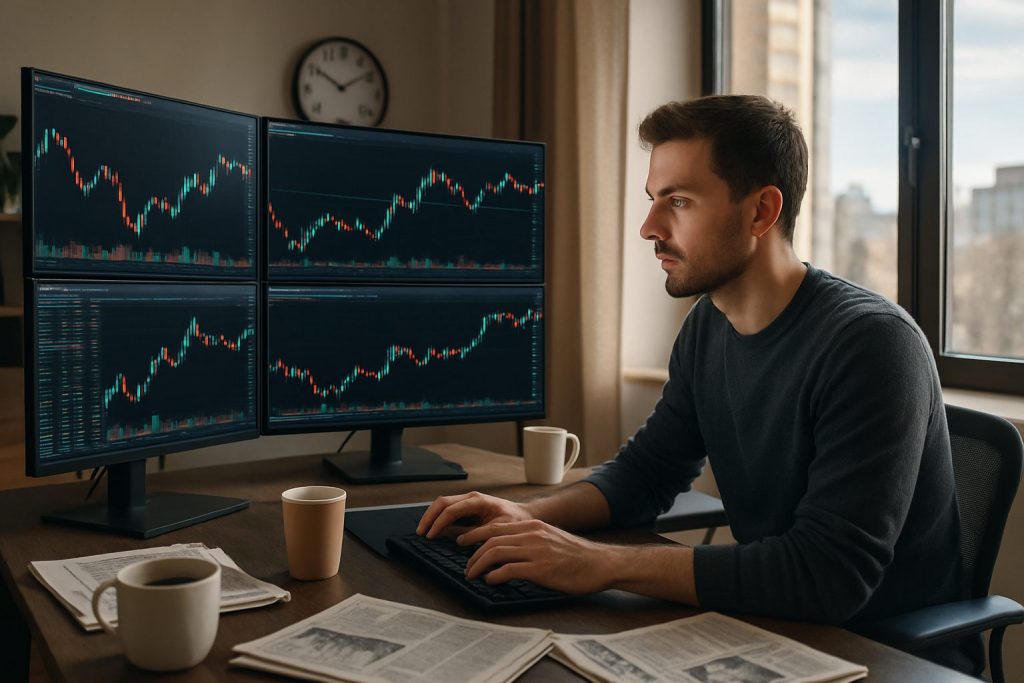
Do day traders work 9 to 5? No — day trading rarely aligns with a traditional 9 to 5 workday.
Many aspiring traders imagine a neat swap: leave the office and adopt a flexible trader lifestyle. The reality is more nuanced. Day trading follows market hours, not the office clock, so a trader’s work hours depend on the chosen market, asset class and strategy. For someone like Alex — a fictional software engineer who trades FX around his job — success required honest time accounting, strict habit formation and choosing a timeframe that fit an evening routine. This overview explains how typical trading schedule patterns differ from a 9-to-5, how part-time approaches can work, and what trade-offs appear in costs, risk and lifestyle. Practical tables and checklists help evaluate whether to aim for daily intraday sessions, evening daily-chart management, or a long-term transition to full-time trading. Links to deeper guides and community resources are included for next steps.
Do day traders work 9 to 5? Typical work hours vs market hours
Day traders rarely match a regular 9-to-5 timetable because the stock market and other financial markets dictate activity peaks. Exchanges open at set times, volatility clusters around those openings, and liquidity varies by session.
- Choose the market and the trader follows its market hours.
- Short-term strategies demand focused blocks during high-volatility windows.
- Longer timeframes compress work into short daily reviews rather than continuous screen time.
| Trading type | Typical market hours | Typical daily work hours | Best fit for |
|---|---|---|---|
| Intraday scalping | Open sessions (e.g., NY, London) | 3–6 concentrated hours | Full-time traders with fast systems |
| Day trading (momentum) | Major session overlaps | 2–5 focused hours | Traders with flexible mornings/afternoons |
| Daily-chart trading | Any (end-of-day analysis) | 30–90 minutes | 9-to-5 professionals, swing traders |
Example: Alex scans daily charts each evening, then executes only a few limit orders during prime session overlap — this keeps screen time short while staying aligned with the trader lifestyle.
Insight: The defining factor is not the “to 5” clock but the chosen market’s rhythm — match schedule to market hours and the work becomes purposeful.
Do day traders work 9 to 5? Trading schedule options for people with a 9-to-5
Balancing a salaried job with trading is doable with a clear trading schedule and realistic time accounting. Start by counting available distraction-free hours, then halve that estimate — a practical step to avoid overcommitment.
- Assess true weekly study and trading time (count only focused blocks).
- Create small, repeatable habits: short daily reviews beat sporadic marathon sessions.
- Pick one timeframe and stick to it to avoid analysis paralysis.
| Option | Weekly time | Tools | Good for |
|---|---|---|---|
| Daily-chart trading | 2–5 hours | End-of-day scans, limit orders | Busy professionals (recommended) |
| Fixed-session day trading | 4–10 hours | Pre-market prep, focused trading window | Shift workers or flexible schedules |
| Weekend study + small weekday trades | 6–12 hours | Backtesting, journaling | Learners building an edge |
Concrete steps: use community feedback, join a mastermind to form disciplined habits, and avoid automating systems before proving an edge. Helpful reading and guides on part-time approaches include resources on whether day trading can be done part-time and how many hours traders work:
- Can day trading be done part-time while working?
- How many hours a day do day traders work?
- Can day traders work from anywhere?
- Can I day trade while traveling?
- Can I day trade while on vacation?
Insight: For 9-to-5 workers, the most sustainable path is a minimal daily routine plus focused weekend study — habit + repetition beats chaotic multitasking.
Do day traders work 9 to 5? Trader lifestyle, costs and long-term choices
Moving from part-time to full-time trading changes the equation: risk tolerance, fixed costs and psychological strain rise. Many underestimate the hidden costs — commissions, slippage, taxes and the value of lost steady income.
- Calculate true profitability after all trading costs before quitting a stable job.
- Automation and bots are tempting but require a tested edge and technical skill.
- Find a community for accountability and avoid YouTube clutter; structured education helps.
| Factor | Part-time trading | Full-time trading |
|---|---|---|
| Income stability | Salary + trading side income | Trading profits only — variable |
| Time commitment | Small, regular blocks | Many hours of research, monitoring |
| Costs | Lower (fewer trades) | Higher (more commissions, data feeds) |
Useful perspectives on career viability and long-term sustainability are available here:
- Is day trading a good career choice?
- Is day trading a sustainable career long-term?
- Can you quit your job to become a day trader?
- Do day traders get job benefits like employees?
Insight: The decision to leave a 9-to-5 should be gradual, data-driven and conservative — treat trading as a business before it becomes a livelihood.
Common questions and practical answers
Can someone with a 9-to-5 become a profitable day trader?
Yes — but the fastest route is often daily-chart trading or fixed-session strategies that fit around work. Build habits, limit distractions and use focused education rather than chasing every new tip.
How many hours do day traders actually work each day?
That varies. Many full-time traders spend 3–8 hours on active trading and another few hours on research and journaling. Part-time traders can progress with 2–6 distraction-free hours per week if time is used efficiently.
Is automation a shortcut for busy traders?
No — automation requires a proven edge, technical setup and monitoring. For most with a 9-to-5, it’s safer to master a manual system first.
Which trading timeframe suits a 9-to-5 worker?
The daily timeframe tends to offer the best balance of low screen time and meaningful signals. For more intense intraday approaches, restrict trades to a fixed window and use limit orders where possible.
Where to learn next?
Start with structured resources and communities, then test ideas with small size and rigorous journaling. See the linked guides above for detailed pathways and case studies.

With over a decade of experience navigating global financial markets, I specialize in identifying trends and managing risk as a professional trader. My passion for economics drives my daily commitment to staying ahead in this fast-paced industry. Outside of the markets, I enjoy exploring technology like cryptocurrencies and new investment strategies.