
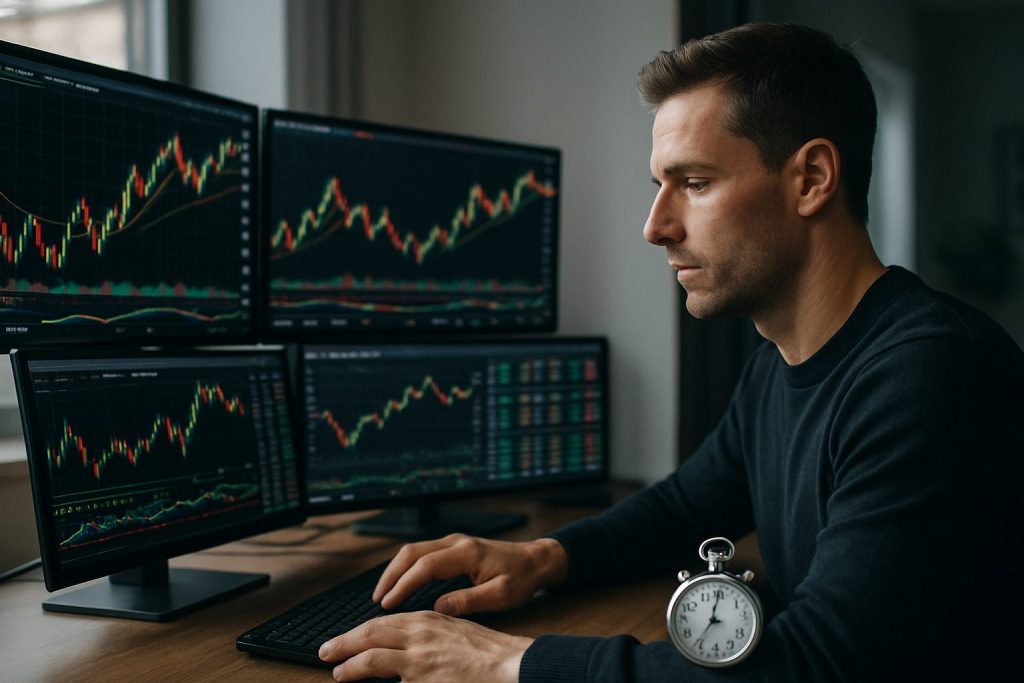
Day trading can be done in short bursts of time, but short bursts of time demand a focused trading strategy, automation, and strict risk management to make intraday trading viable.
Part-time schedules and busy lives no longer preclude active participation in the financial markets. With the right approach, day trading in short bursts—whether through quick trades, scalping, or concentrated intraday trading windows—can be effective. A teacher who scans markets for 20 minutes before class, a nurse who takes two high-volatility 30-minute sessions, or a developer using automated bracket orders all illustrate how limited time can be transformed into productive trading sessions. Preparation done on weekends, targeted use of scanners and alerts, and mobile-friendly platforms like Pocket Option, Quotex or Olymp Trade allow trades to be placed and managed without watching screens all day. This piece explains practical routines, choice of time frames, examples of quick setups, and the emotional and risk controls needed to trade profitably in limited windows.
How short-burst day trading works: intraday trading, scalping and focused time frames
Short-burst day trading focuses activity on the most productive moments of a session. Rather than monitoring the full trading day, traders concentrate on high market volatility windows and predefined setups. Examples include scalping on a one-minute chart or taking a few trend-break entries on a 15-minute chart.
- Peak windows: trade during the first and last 30–60 minutes of major sessions or session overlaps.
- Scalping: many quick trades with tight stops and small targets.
- Bracket orders: set entry, stop loss and take-profit levels to manage trades automatically.
| Approach | Typical time frame | Best for |
|---|---|---|
| Scalping | 1–5 minute charts | Quick trades, high-frequency setups |
| Short intraday swings | 15–60 minute charts | Fewer trades, higher reward targets |
| Micro-session trading | Pre-defined 30–90 minute windows | Part-time traders, busy schedules |
Insight: Concentrating on time frames that match availability reduces noise and increases the edge.
Practical routines, tools and automation to trade in short bursts
Efficiency is the core of successful part-time day trading. The combination of weekend preparation, concise pre-session routines, and automation turns limited minutes into opportunities. Traders can rely on scanners, alerts, and bracket orders to ensure trades execute while attention is elsewhere.
- Weekend work: update watchlists, backtest setups, and schedule alerts.
- 15-minute pre-session routine: check index futures, economic calendar, pre-market movers, and place orders.
- Automate aggressively: use scanners, price alerts and bracket orders on platforms like Pocket Option, Quotex or Olymp Trade.
| Task | Minutes | Why it matters |
|---|---|---|
| Futures/Index scan | 2–3 | Quick read of market bias and volatility |
| Pre-market movers | 3–5 | Identify candidates for quick trades |
| Set orders & alerts | 4–5 | Allows trades to run without constant monitoring |
Example: A fictional teacher named Aisha scans her watchlist for 15 minutes, places bracket orders for two setups, then focuses on her job while trades run. The results are logged in a 5-minute post-session review.
Insight: Proper preparation and the right tools let traders capture the best of intraday volatility without full-time commitment.
Risk management, psychology and choosing the right trading strategy for quick trades
Short bursts magnify the importance of disciplined risk management and a simple trading plan. With less time to react, decisions must be pre-planned and size must be conservative. The “bracket master” approach—entry, stop loss, multiple take-profit levels and trailing stops—removes emotion and enforces rules.
- Position sizing: use a formula to size positions according to risk per trade.
- Strict criteria: only trade setups that meet predefined rules to avoid FOMO trading.
- Max loss per day: set firm limits to preserve capital and peace of mind.
| Risk element | Recommendation | Quick example |
|---|---|---|
| Risk per trade | 1–2% of capital | Risk $200 on $10,000 account |
| Stop placement | Based on volatility, not guesswork | Use ATR or recent swing low/high |
| Daily limit | Cap losses to avoid tilt | Stop trading after 3 consecutive losing trades |
Insight: Sound risk management converts short bursts into a repeatable edge rather than luck.
Choosing the right path: part-time day trading, swing trading or a hybrid approach
Short bursts can be a gateway to sustainable trading, or they can push traders toward less frequent time frames. Many part-time traders adopt a hybrid model: a core passive portfolio, position trades for major moves, and occasional day trades during prime volatility windows.
- Hybrid portfolio: passive investments plus targeted intraday trades.
- Swing trading alternative: 30–60 minutes daily for setups that hold days to weeks.
- Progression: expand active time only after consistent profitability.
| Approach | Daily time | Best for |
|---|---|---|
| Part-time day trading | 30–120 minutes | Supplemental income, high-focus windows |
| Swing trading | 30–60 minutes | Lower stress, fewer decisions |
| Position trading | 2–4 hours weekly | Long-term trend capture |
Insight: Time-efficient trading combines a long-term core with selective short-burst activity for balance and resilience.
Resources, further reading and practical tools for traders with limited time
To learn more about balancing trading with other commitments, expected time investment, career paths and sustainability, explore focused guides that cover these exact concerns. Practical links are collected to deepen understanding and plan long-term goals.
- Can day trading be done part-time while working?
- How much time should beginners spend on day trading?
- Can I balance day trading with a regular job?
- Can you make a living off day trading?
- Is day trading a sustainable career long-term?
| Tool | Purpose | Suggested use |
|---|---|---|
| Scanner | Spot high-probability setups | Run before each short session |
| Mobile app | Execute/monitor trades on-the-go | Platforms: Pocket Option, Quotex, Olymp Trade |
| Bracket orders | Automate exits | Protect capital when attention is limited |
Insight: The right tools compress hours of work into minutes, making short-burst trading practical and repeatable.
Common questions about day trading in short bursts
Can reliable profits be made from day trading in short bursts?
Yes—profitability is possible, but it depends on edge, discipline, and consistent preparation. Trading in short bursts amplifies the need for a robust trading strategy and strict risk controls.
Which trading strategy suits limited time: scalping or swing trading?
Both can work. Scalping fits very short bursts but demands rapid execution and low latency. Swing trading requires less daily attention and can be a sustainable alternative if time is scarce.
How should position size be calculated for quick trades?
Use a simple size calculator: Position size = Risk per trade / (Entry price – Stop loss price). This keeps risk consistent even when trades are fast.
Can automated orders replace manual oversight?
They can reduce the need for constant monitoring but must be tested first. The “bracket master” method reduces emotional decisions and makes short-burst trading safer.
Are there recommended platforms for mobile short-burst trading?
Platforms with reliable mobile apps and bracket order features are best. Consider Pocket Option, Quotex, and Olymp Trade for handheld execution and alerts.

With over a decade of experience navigating global financial markets, I specialize in identifying trends and managing risk as a professional trader. My passion for economics drives my daily commitment to staying ahead in this fast-paced industry. Outside of the markets, I enjoy exploring technology like cryptocurrencies and new investment strategies.