
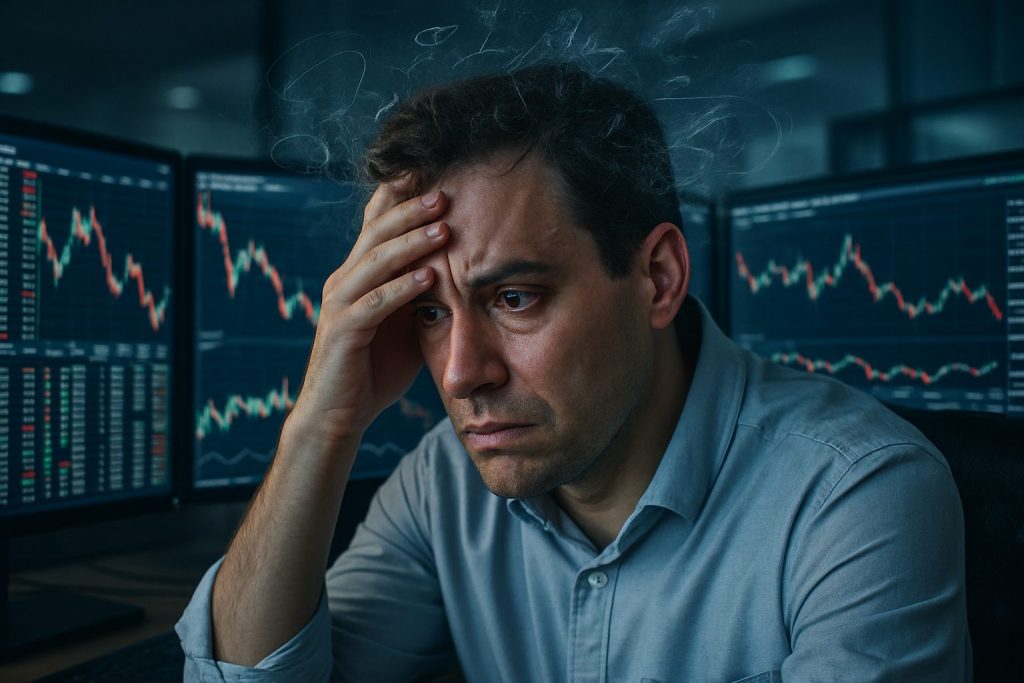
Can day trading cause anxiety? Yes — day trading can cause anxiety, especially when risk management is weak, market volatility spikes, or personal temperament meets high-pressure execution.
Fast markets and instant feedback turn small choices into emotional tests. In 2025’s relentlessly connected financial markets, intraday traders face constant news, leverage, and visible profit-and-loss swings that can trigger physiological stress responses. This piece examines the drivers of day trading anxiety, practical steps to reduce investment stress, platform choices suited to learning (Pocket Option, Quotex, Olymp Trade), and a worked example for a €100 scenario. Each section offers lists, clear examples, and a table to help beginners build resilient routines and better trading psychology. Links to focused resources encourage demo-first practice and deeper reading on how to manage stress while learning a rules-based approach.
Why day trading often triggers anxiety in fast markets
Day trading’s structure — rapid decisions, immediate outcomes, and frequent feedback loops — primes the nervous system for repeated stress. The combination of small account sizes, leverage, and unpredictable volatility creates a high-stakes environment that interacts with human biases like loss aversion and perfectionism.
- Immediate feedback: wins and losses known within minutes increase emotional reactivity.
- Leverage amplification: small moves create large equity swings, magnifying anxiety.
- Continuous news flow: 24/5 forex and round-the-clock crypto feeds raise hypervigilance.
Recognising the mechanics behind the emotional impact makes it possible to design defenses rather than be controlled by them. Learn more about how market structure affects traders at can day trading cause financial stress.
Final insight: when markets move fast, structure and limits are the antidote to reactive decisions.
Psychological and physiological drivers of trading stress
Trading anxiety is not failure; it is a natural reaction to perceived threat. Understanding the biology helps build coping protocols.
- Fight-or-flight response: rapid heart rate, sweating, tunnel vision during big market moves.
- Cognitive overload: too many indicators and social noise cause indecision and rumination.
- Behavioural traps: revenge trading after losses, or freezing and avoiding setups.
Explore practical coping mechanisms at how do day traders manage stress.
Final insight: treat physiological signs as data — implement pre-planned rituals to reset before acting.
Common symptoms of day trading anxiety and warning signs
Awareness of early symptoms prevents escalation into chronic mental health problems or destructive trading behaviors.
- Racing thoughts, difficulty sleeping after trading sessions.
- Rule-breaking: moving stops, over-sizing, or impulsive entries.
- Social withdrawal or relationship tension tied to trading outcomes.
| Symptom | Typical trigger | Immediate action |
|---|---|---|
| Sleeplessness | Large intraday loss or high volatility | Stop trading for the day; short relaxation routine |
| Revenge trading | Attempt to immediately recover a loss | Enforce session loss limit; log emotion in journal |
| Analysis paralysis | Information overload | Simplify to one timeframe and one setup |
For more on how trading affects relationships and isolation, see can day trading affect relationships and can day trading cause isolation.
Final insight: early detection + immediate, simple rules stops emotion-driven escalation.
Practical steps to reduce anxiety: a phased, rules-based plan
Begin with education, move to demo practice, then scale with strict risk management. The aim is to convert emotional reactions into disciplined responses.
- Learn one setup: focus on breakout, pullback, or momentum — master entries and stops.
- Demo until automatic: practice until executions feel procedural, not emotional.
- Define risk per trade: commonly 1% or less of account balance to avoid large swings.
- Session limits: choose limited hours to prevent fatigue and round-the-clock stress.
- Journal and review: track outcomes and emotions weekly to spot patterns.
| Phase | Action | Goal |
|---|---|---|
| Education | Read, watch, and demo a single strategy | Build conceptual clarity |
| Practice | 100 demo trades with rules | Make execution reflexive |
| Scale | Small real account, strict risk caps | Preserve capital and confidence |
Suggested resource for demo-first practice: what is the best trading platform for beginners. Also review recovery and weekend breaks at do day traders have weekends off.
Final insight: a phased plan reduces uncertainty — certainty in rules beats certainty in outcomes.
Short break: the next section shows real tools and a worked example using Pocket Option to demonstrate practical risk limits.
Tools, platforms, and a worked Pocket Option example (€100 trade)
Select platforms that offer a reliable demo, a simple UI, and clear position-sizing tools. For beginners, Pocket Option, Quotex, and Olymp Trade are commonly used demo-friendly choices.
- Pocket Option: unlimited demo, low minimum deposits, user-friendly — ideal for learning execution and rules.
- Quotex: simple interface and demo features suited for strategy testing.
- Olymp Trade: structured educational resources and demo accounts for practice.
| Platform | Demo | Best for |
|---|---|---|
| Pocket Option | Yes — unlimited | Beginners focusing on execution and risk rules |
| Quotex | Yes | Strategy testing with simple UI |
| Olymp Trade | Yes | Education-focused beginners |
Example: a €100 account using Pocket Option with 1% risk per trade.
- Account balance: €100
- Risk per trade: 1% = €1
- Stop-loss distance: 20 pips (example on EUR/USD)
- Position size formula: lots = risk amount ÷ (stop-loss pips × pip value)
| Parameter | Value |
|---|---|
| Account | €100 |
| Risk per trade | €1 (1%) |
| Stop-loss | 20 pips |
| Calculated lot | Small micro lot sized to limit loss to €1 |
Before trading live, test the sequence: demo 50–100 trades on Pocket Option, follow rules, then consider a micro real account. Read about platform choices and travel questions at can i day trade while traveling and platform-specific forex info at is oanda good for forex day trading (contextual comparison).
Final insight: clear math and demo repetition convert fear into measurable, limited risk.
Common strategies and rules to reduce emotional trading
Rule-based strategies turn subjective impulses into objective steps. Choose a simple approach and enforce it.
- Breakout with fixed stop/target: defined entry, stop, and take-profit removes ambiguity.
- Pullback to moving average: fewer signals, better timing, reduced overtrading.
- Schedule-based trading: trade only during set sessions to limit exposure.
Practical rules to implement:
- Risk ≤ 1% per trade.
- Stop after 2 consecutive losses.
- Keep weekly review and one no-trade day.
For discussion about trading addiction and risk of gambling-like behavior, consult is day trading addictive like gambling.
Final insight: simple, enforceable rules preserve capital and mental well-being.
Resources, habits, and next steps for healthier trading psychology
Long-term resilience blends technical skill with daily habits that protect mental health. The goal is to keep learning while containing stress.
- Daily routine: pre-trade checklist, breathing exercise, defined hours.
- Weekly review: trade journal, emotion notes, plan adjustments.
- Professional help: seek counselling if anxiety persists beyond trading context.
Additional reading: can day trading cause anxiety and practical stress guides at can day trading cause financial stress.
Final insight: habits and small protective rules are the most reliable buffers against market volatility.
FAQ
- Can day trading cause anxiety long-term?
Yes — without rules and limits, repeated exposure to volatile financial markets can create chronic stress; structured practice and counselling when needed help manage long-term effects.
- Which platform is best to learn without pressure?
Pocket Option, Quotex, and Olymp Trade all offer demo accounts; Pocket Option is often recommended for beginners due to an unlimited demo and simple UI.
- How much should a beginner risk per trade?
Commonly 1% or less of the account balance per trade; this risk management cap prevents single trades from causing debilitating anxiety.
- Are there quick techniques to calm down during a trade?
Yes — a short breathing routine, pausing the screen, and following a pre-defined stop-loss rule reduce immediate physiological reactivity.
- When should a trader seek professional help?
If trading-related worry affects sleep, relationships, or daily functioning, consult a mental health professional to separate trading stress from broader anxiety disorders.

With over a decade of experience navigating global financial markets, I specialize in identifying trends and managing risk as a professional trader. My passion for economics drives my daily commitment to staying ahead in this fast-paced industry. Outside of the markets, I enjoy exploring technology like cryptocurrencies and new investment strategies.