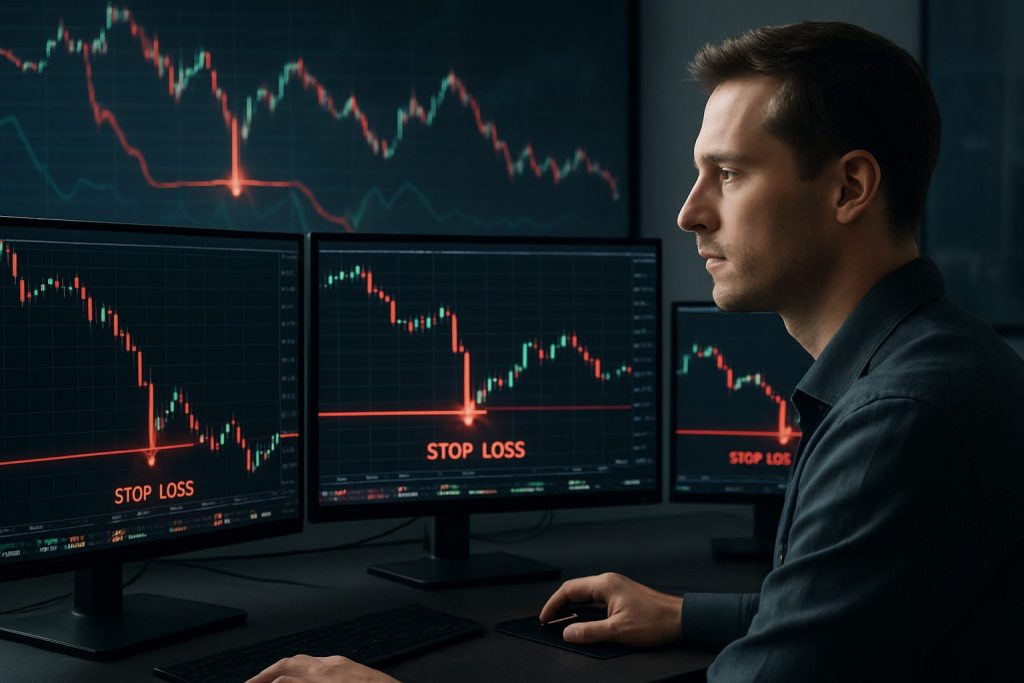
Can stop losses protect me from big losses? Stop losses can protect from big losses in normal market conditions, but they cannot guarantee protection against overnight gaps, extreme market volatility, low liquidity, or deliberate stop hunting.
A stop loss is one of the first lines of defense in a trading plan, designed to enforce trade discipline and support capital preservation. Yet real markets are noisy and sometimes brutal: sudden gaps, trading halts, or aggressive liquidity sweeps can nullify a neat stop-loss plan and turn a controlled loss into a much larger drawdown. Understanding how stop loss orders interact with market volatility and with big players who hunt liquidity transforms an emotional loss into a learning edge. Practical methods — volatility-based stops, position sizing, mental stops, and waiting for confirmation — are tools to combine with stop losses for stronger investment protection and loss prevention. On platforms such as Pocket Option, Quotex, and Olymp Trade, execution rules and order types matter for the real-world effectiveness of a stop loss order.
How stop loss orders work and why they sometimes fail — stop-loss mechanics and limits
A stop loss order turns a risk plan into an automated exit: once price touches the trigger, the order becomes active. In most liquid environments this limits losses and reduces emotional errors, supporting robust risk management. However, several market conditions can prevent a stop from delivering the intended protection.
- Overnight gaps: Markets can open far from the previous close, so the stop may be filled at a much worse price.
- Poor liquidity: Thin markets cause slippage; a stop that becomes a market order can suffer heavy execution slippage.
- Stop hunting / liquidity sweeps: Large players may intentionally trigger clustered stops to create liquidity and then reverse the market.
- Trading halts and freezes: Orders cannot execute when markets are suspended.
| Scenario | How it breaks stop losses | Best mitigation |
|---|---|---|
| Overnight gap | Stop triggered at a much worse opening price due to gap | Use conservative position sizing; avoid open overnight or use limit protections |
| Stop hunting | Clusters of obvious stops are swept, then price reverses | Place volatility-based stops (ATR), avoid obvious round-number stops |
| Poor liquidity | Market order fills with slippage | Trade liquid instruments and reduce size; prefer limit exits if necessary |
| Trading halt | No execution until market reopens | Use smaller position sizes; diversify across markets |
Stop hunting: a practical example and what it reveals
Large participants seeking liquidity will push price through clustered stops, creating a cascade of market sells that they then absorb. This is not always illegal; it is often a consequence of professional traders needing deep liquidity. The result: retail traders can be shaken out at the worst moment, then watch the instrument reverse sharply.
- Clusters form under obvious support and round numbers — a magnet for liquidity.
- Institutions use aggressive orders to create and then buy the flood of sell orders.
- After the sweep, price often snaps back, leaving stopped retail traders out of a long position.
Key insight: Avoid placing stops where the crowd places them — think like the liquidity seeker, not the herd.
Advanced defenses: combining stop losses with volatility-aware tools and position sizing
Stop losses should be part of a broader risk management framework. Using volatility metrics like ATR and strict position-sizing rules strengthens financial safety and reduces the chance that a single event destroys the account.
- ATR-based stops: Set stops as a multiple of the Average True Range to stay outside normal noise.
- Position sizing: Adjust trade size so the dollar risk fits the plan — wide stops require smaller positions.
- Trade discipline: Commit to a fixed % risk per trade (commonly 1–3%) to preserve capital.
- Wait for confirmation: Let higher timeframe closes validate breakouts, avoiding false moves.
| Tool | Purpose | Typical rule |
|---|---|---|
| ATR stop | Place stop outside market noise | 2× ATR below entry/support |
| Fixed % risk | Limit drawdown per trade | 1–3% of account per trade |
| Mental stop / alert | Avoid visible order on the book | Use alerts and manual exit discipline |
On platforms like Pocket Option, Quotex, and Olymp Trade, the available order types and execution delays change how effective any stop will be. It is essential to test how a chosen platform handles stops during volatile sessions and to read execution policies carefully. For beginners, resources such as how much to risk with a $100 account and how much to risk with a $500 account help translate percent risk into real position sizes.
Practical trading strategies to limit big losses — workflows and rules to adopt
Combining simple processes with consistent rules creates investment protection that survives market shocks. The following workflow is an actionable template for protective trading strategies.
- Define maximum account risk per trade (e.g., 1–2%). See guides like how much beginners should risk per trade.
- Compute ATR and set stop at 1.5–3× ATR depending on timeframe.
- Adjust position size so the monetary risk at that stop equals the allowed risk. For examples of beginner pitfalls, read do beginners risk too much per trade?
- Place alerts instead of visible orders for sensitive levels, or use limit protection if the platform supports it.
- Monitor macro events that can create gaps; avoid carrying risk through those windows.
- Trade liquid markets to reduce slippage and execution surprises.
- Use multiple, small positions instead of one oversized bet.
- Keep a trading journal to preserve trade discipline and refine the approach.
For those building resilience, check practical reads about trading behavior such as why beginners trade without stop losses and why beginners ignore risk management. These explain the psychology behind predictable stop placement and how to break that pattern. Final insight: robust loss prevention is the sum of good stops, correct sizing, and calm execution.
Questions traders commonly ask about stop losses and big losses
Do stop losses always protect against large losses?
No. Stop losses greatly reduce the chance of catastrophic drawdowns under normal conditions, but they cannot guarantee protection from gaps, halts, or aggressive liquidity sweeps. Combine them with position sizing and volatility-aware stops for stronger protection.
How wide should a stop loss be to avoid being hunted?
Use volatility measures like ATR to set stops outside normal noise — commonly 1.5–3× ATR. Wider stops require smaller positions; this trade-off preserves capital preservation and reduces the chance of being taken out by short bursts of volatility.
Are mental stops better than placed stop-loss orders?
Mental stops hide intentions from hunters but demand strict discipline and can lead to larger slippage in fast moves. A hybrid approach — alerts plus manual review, or using limit-based protections on platforms that support them — balances invisibility and execution certainty.
What should a beginner focus on first: stop placement or position sizing?
Position sizing is foundational. Ensuring no single trade can wipe out an account offers immediate financial safety. After that, refine stop placement with ATR and test on the chosen platform such as Pocket Option, Quotex, or Olymp Trade.
Where to learn realistic expectations for losses and frequency?
Study beginner loss statistics and realistic risk rules; resources like what is the average beginner loss and why beginners trade too often help set practical benchmarks. Remember: protection is a system, not a single order.

With over a decade of experience navigating global financial markets, I specialize in identifying trends and managing risk as a professional trader. My passion for economics drives my daily commitment to staying ahead in this fast-paced industry. Outside of the markets, I enjoy exploring technology like cryptocurrencies and new investment strategies.