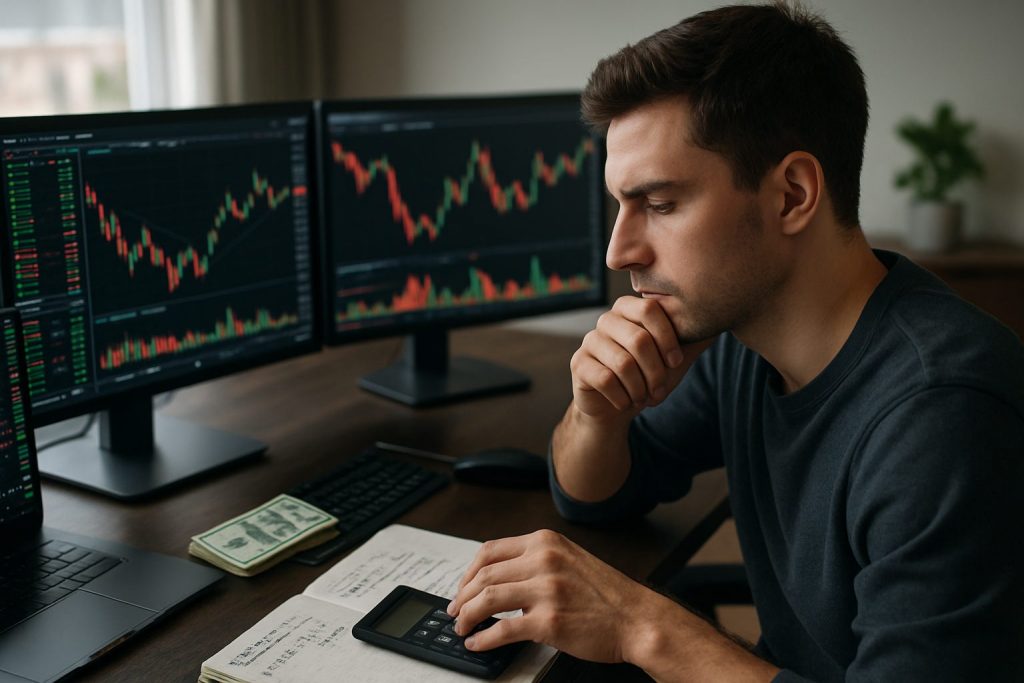
How much should I risk with a $100 account? Risk about 1% per trade (≈$1) — up to 2% only with strict stop-loss rules and proven money management.
Small accounts demand discipline more than daring moves. A $100 trading account exposes a trader to rapid swings when leverage and position sizing are misused, so the focus must be on capital preservation, solid risk management, and building a repeatable trading strategy. This guidance is not for US residents and assumes use of platforms such as Pocket Option, Quotex, or Olymp Trade. The examples below show practical position sizing, stop loss placement, and how to grow a small account without gambling. Readers will find checklists, a clear table to size positions, embedded tutorials, and links to deeper reads on common beginner errors like trading too often or skipping stop losses. A fictional beginner, Luca, will serve as a thread: he starts by risking tiny fractions to survive losing streaks and learn to compound gains slowly.
Risk per trade for a $100 account — why the 1% rule matters
Risking about 1% of account size per trade preserves the ability to survive multiple losing trades and protects mental capital. With $100, that means risking roughly $1 on any single position; stretching to 2% (≈$2) should be a conscious, rare choice tied to proven edge and strong risk tolerance.
- Survival first: Small drawdowns allow time to learn without a forced stop-out.
- Mental clarity: Lower trading risk avoids panic and revenge trading after losses.
- Edge testing: Low risk per trade lets a strategy reveal its statistics across many trades.
Common beginner behaviors — like trading too often or skipping stop losses — accelerate account depletion. Read more on why novices trade too frequently and skip safeguards: why do beginners trade too often? and why do beginners trade without stop losses?.
Insight: Protecting the account is the highest priority — without capital, there is no chance to compound learning into growth.
Position sizing, stop loss and practical examples for a $100 account
Position sizing translates the chosen risk per trade into a concrete lot size or contract size on platforms like Pocket Option, Quotex, or Olymp Trade. Use a stop loss to cap losses and always calculate position size before placing an order.
- Calculate risk amount: Account balance × risk per trade (e.g., $100 × 1% = $1).
- Set stop loss in pips or percent: Decide acceptable movement and convert to position size.
- Use micro-lots or smallest contract sizes: This enables precise position sizing on small accounts.
| Risk per trade | $ Risk on $100 | Suggested strategy | Suggested leverage range |
|---|---|---|---|
| 0.5% | $0.50 | Very conservative: learning phase, long-term holds | 1:5 – 1:20 |
| 1% | $1 | Standard: day trading with tight stops, swing trades | 1:10 – 1:50 |
| 2% | $2 | Higher-risk test trades only with strict rules | 1:20 – 1:100 |
| >2% | $3+ | Not recommended for most beginners — high chance of ruin | Use extreme caution |
Practical example for Luca: with a $100 account and a 20‑pip stop on EUR/USD, Luca calculates the micro‑lot size that equates to a $1 risk — that prevents emotional resizing mid‑trade and enforces discipline.
- Always place a stop loss to cap the predefined risk.
- Combine position sizing with a clear risk-reward ratio before entry; see: what is risk-reward ratio in day trading?
- Track each trade in a simple journal to measure the strategy’s edge.
Insight: Position sizing plus a stop loss turns goals into repeatable processes rather than hopeful bets.
Common mistakes, small-account growth plan and emotional control
Beginners often fall into emotional traps that destroy small accounts quickly. The path to steady growth is a plan, not luck. Luca avoided early ruin by following a checklist and iterating his plan after each losing streak.
- Avoid overtrading: Frequent, low‑quality trades reduce edge — learn why here: why-do-beginners-trade-too-often.
- Never trade without a stop loss: Read on: why-do-beginners-trade-without-stop-losses.
- Be cautious with copying or bots: Understand risks: is-copy-trading-less-risky-than-day-trading and are-bots-safer-for-beginners-than-manual-trading.
Growth plan checklist for a $100 account:
- Set a clear risk per trade (start at 0.5–1%).
- Use micro positions and strict stop loss.
- Limit daily max loss (e.g., 3% of account) to avoid ruin.
- Journal trades, measure win rate and average R:R, then adjust position sizing.
- Gradually increase risk only after consistent positive expectancy.
For those tempted to chase quick returns, read: do-beginners-risk-too-much-per-trade and how-much-should-beginners-risk-per-trade to understand common pitfalls.
Insight: Small consistent gains compound; protecting the account enables the luxury of time to discover a true edge.
Common questions about how much to risk with a $100 account
Is 2% per trade acceptable on a $100 account?
Yes, but only if there is a clear edge, strict stop-loss rules, and the trader accepts increased volatility and psychological pressure. For most beginners, 1% or less is wiser.
What stop loss distance should be used when risking $1?
Stop loss should reflect market structure, not an arbitrary pip count. Convert the chosen pip distance into dollar risk and adjust position size so that the dollar risk equals the planned risk per trade (e.g., $1).
Can copy trading or bots protect a $100 account?
Copy trading and bots can help but are not guaranteed safety nets. They often hide execution differences and past-performance bias. Read more on safety and limitations: is copy trading less risky and are bots safer.
How do risk tolerance and account size interact?
Smaller account size means less room for error; therefore, risk tolerance should be conservative. A trader with low tolerance should pick 0.5–1% risk per trade to protect capital and mental state.
Where to learn more about avoiding beginner pitfalls?
Explore practical reads on recurring mistakes and how to stop them: why-do-beginners-ignore-risk-management and what-is-the-best-risk-reward-for-beginners.

With over a decade of experience navigating global financial markets, I specialize in identifying trends and managing risk as a professional trader. My passion for economics drives my daily commitment to staying ahead in this fast-paced industry. Outside of the markets, I enjoy exploring technology like cryptocurrencies and new investment strategies.