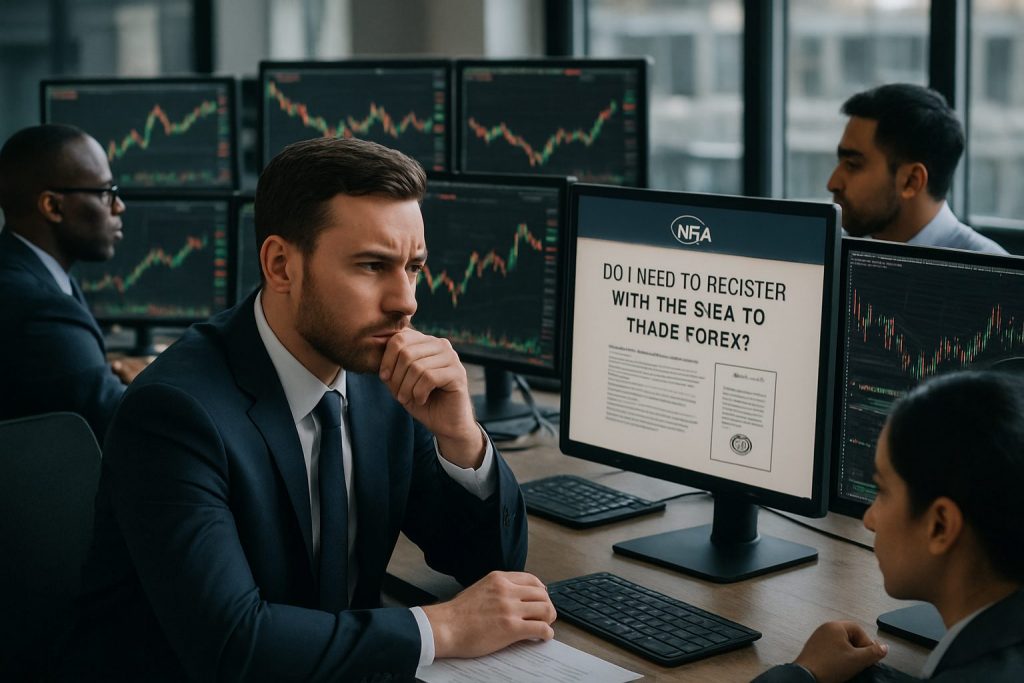
Do I need to register with the NFA to trade forex? For most retail forex traders who trade as clients, one does not need to register with the NFA; register with NFA obligations apply to firms and professionals such as brokers, Commodity Trading Advisors, and Futures Commission Merchants.
Trading forex brings both opportunity and risk, and understanding whether to register with NFA matters most for those who run a trading business rather than those who trade as retail clients. This piece explains the distinction between individual trader obligations and firm-level NFA registration, and shows how NFA forex rules and NFA requirements protect market integrity. It is important to note this content is not for US residents — the NFA governs U.S. derivatives and forex markets, and the rules described are framed for readers evaluating regulatory landscapes or choosing non-U.S. platforms. Read on to learn who must comply with NFA compliance, how to verify NFA forex registration, and practical checks when considering brokers such as Pocket Option, Quotex, or Olymp Trade for trading outside U.S. jurisdiction. For deeper reading on registration nuances and other regulatory matters visit this resource: https://tradingpriceactiononfutures.com/do-i-need-to-register-with-the-sec-to-day-trade/
Who must register with the NFA to trade forex? — clear roles and NFA requirements
Not everyone involved in forex trading needs NFA registration. The key distinction is between being a retail forex trader (client) and acting in a professional or firm capacity. The NFA requirements focus on entities that provide trading services, advice, or custody — roles that affect other people’s money.
- Who must register: Futures Commission Merchants (FCMs), Forex Dealer Members (FDMs), Introducing Brokers (IBs), Commodity Trading Advisors (CTAs), Commodity Pool Operators (CPOs), and certain associated persons.
- Who typically does not register: Individual retail forex clients trading their own capital without offering services to others.
- Why it matters: Registration triggers reporting, capital, segregation, and audit rules that protect counterparties and retail clients.
| Role | Must register with NFA? | Key obligations |
|---|---|---|
| Retail individual forex trader | No | Follow broker rules; no firm-level reporting |
| Forex broker / FDM | Yes | Segregation of client funds, minimum capital, audits |
| Introducing Broker (IB) | Often yes | Disclosure, background checks, client referrals |
| CTA / CPO managing others’ money | Yes | Registration, periodic reporting, client disclosures |
Practical example: a small trading group that accepts outside capital for pooled strategies usually must complete forex trader registration or register the pooled vehicle — this shifts the entity into the NFA’s scope. For further context on registration parallels, consult this guide: https://tradingpriceactiononfutures.com/do-i-need-to-register-with-the-sec-to-day-trade/.
- Check whether the activity involves handling client funds, giving paid advice, or offering order execution.
- Assess whether the organization markets services in the U.S. — that often triggers NFA registration.
- Remember: trading as a private individual for personal gain rarely requires registration.
Insight: the easiest way to know if registration applies is to map activities — if they serve or handle other people’s money, NFA requirements likely apply.
How to verify NFA registration and trade forex legally when using non-US platforms
Verification is a practical step for anyone comparing platforms or assessing risk. Even if the reader is not a U.S. resident, understanding NFA compliance helps measure a broker’s transparency and protections. Use public tools and a checklist to confirm status before placing funds.
- Use the NFA BASIC database to confirm a firm’s registration number and disciplinary history.
- Request audited financials or proof of client fund segregation from the provider.
- Compare forex regulations across jurisdictions to decide acceptable counterparty risk.
| Verification step | What to look for | Why it matters |
|---|---|---|
| Search NFA BASIC | Registration number, member type, enforcement history | Confirms legal status and past issues |
| Review disclosures | Capital requirements, segregation statements, fees | Shows financial transparency |
| Ask for audited statements | Recent audited balance sheet or capital attestation | Confirms solvency and compliance |
If choosing platforms that serve non-U.S. clients, such as Pocket Option, Quotex, or Olymp Trade, compare their disclosures to NFA forex rules as a benchmark. Use reliable resources for comparisons: https://tradingpriceactiononfutures.com/do-i-need-to-register-with-the-sec-to-day-trade/
- Keep records of any regulatory confirmations from the broker.
- Insist on clear withdrawal and custody procedures to reduce counterparty risk.
- Use demo testing, small initial deposits, and staged funding to validate execution and claims.
Insight: verifying NFA forex registration or using it as a benchmark reduces surprises and makes evaluating non-U.S. brokers more structured.
Practical checklist before funding an account (short actionable list)
- Confirm whether the entity is listed in NFA BASIC or an equivalent regulator.
- Ask for proof of client fund segregation and audited statements.
- Read the client agreement for dispute resolution clauses and arbitration language.
- Compare leverage, margin, and order execution policies to NFA requirements.
- Start small and test withdrawals to confirm operational integrity.
For additional background and parallels with other registration questions, consult this reference: https://tradingpriceactiononfutures.com/do-i-need-to-register-with-the-sec-to-day-trade/. Final practical insight: treat NFA registration as a high standard — even when trading through non-U.S. brokers, measuring them against that standard helps protect capital.
Common myths about NFA registration and forex trading
- Myth: “All forex brokers must register with NFA.” — Reality: only those operating or offering services under U.S. jurisdiction or handling others’ funds typically must register with NFA.
- Myth: “If a broker isn’t NFA-registered it’s necessarily fraudulent.” — Reality: non-U.S. regulators vary; lack of NFA status raises caution but isn’t automatic proof of fraud.
- Myth: “Retail traders always need to register.” — Reality: most retail individuals trading personal funds do not require registration.
Insight: separating myths from facts helps focus on the real questions — who handles money, where services are offered, and what protections exist.
Further reading and resources: check official NFA tools and keep this link handy for cross-regulatory context: https://tradingpriceactiononfutures.com/do-i-need-to-register-with-the-sec-to-day-trade/. Also verify platform disclosures for Pocket Option, Quotex, or Olymp Trade before trading: https://tradingpriceactiononfutures.com/do-i-need-to-register-with-the-sec-to-day-trade/.
Quick case study: a small fund deciding on registration
A hypothetical trader group forming a pooled account must determine if the vehicle meets the NFA requirements for registration. They review whether they accept external capital, how custody is handled, and whether offering advice for compensation is involved. After mapping activities they discover registration is required because they manage others’ funds. They then prepare audited records, implement segregation, and register — avoiding later enforcement risk. This demonstrates the causal link between activity and obligation. Final insight: the trigger for NFA registration is activity, not intentions.
Useful reference: before taking any final step, compare regulatory claims and documentation with authoritative sources: https://tradingpriceactiononfutures.com/do-i-need-to-register-with-the-sec-to-day-trade/.
Questions & Answers
- Do retail traders need to register with the NFA? — Retail traders who trade only their own capital generally do not need to register; NFA registration targets firms and professionals.
- How to check if a firm is NFA-compliant? — Use the NFA BASIC database, ask for registration numbers and audited statements, and review enforcement history.
- What protections do NFA rules provide? — NFA forex rules enforce segregation of client funds, capital requirements, recordkeeping, and dispute mechanisms.
- Can non-US brokers match NFA protections? — Some non-U.S. platforms adopt similar safeguards; compare disclosures to NFA standards and test operations before funding.
- Where to learn more? — Start with official NFA resources and trusted industry guides like this one: https://tradingpriceactiononfutures.com/do-i-need-to-register-with-the-sec-to-day-trade/.

With over a decade of experience navigating global financial markets, I specialize in identifying trends and managing risk as a professional trader. My passion for economics drives my daily commitment to staying ahead in this fast-paced industry. Outside of the markets, I enjoy exploring technology like cryptocurrencies and new investment strategies.