
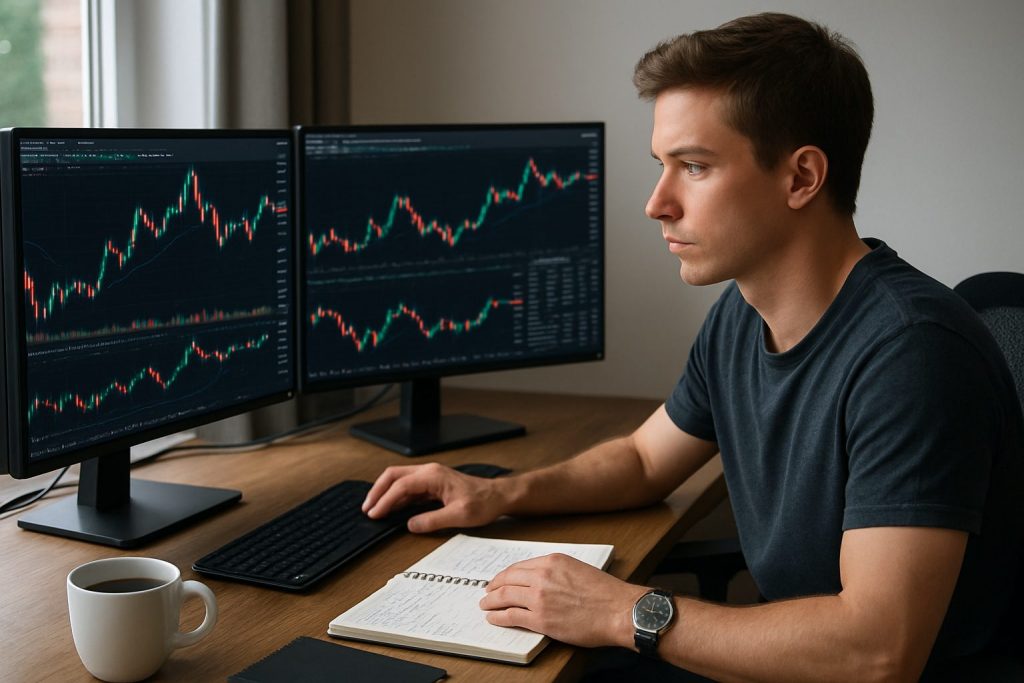
How much time should beginners spend on day trading? Beginners should spend about 3–4 hours of focused trading hours per day for the first 90 days, plus 1–2 hours of study and journaling.
How much time should beginners spend on day trading? That routine balances live market exposure with deliberate learning.
Day trading for newcomers is less a sprint than a disciplined apprenticeship: a structured daily window at the market open, focused study blocks, and methodical review build pattern recognition and emotional resilience. This article outlines a practical schedule for beginners, a 90-day training plan, and actionable rules for time management, trading practice, market analysis and risk management. Expect a realistic learning curve of 6–12 months to reach consistent results if commitment is maintained. Use demo accounts on platforms such as Pocket Option, Quotex or Olymp Trade to record trades, build a repeatable routine, and avoid the five common beginner mistakes that destroy accounts. Practical schedules, one robust setup, and strict sizing rules will protect capital and speed progress in investment education.
How much time beginners should spend on day trading: daily schedule and first 90 days
A reproducible daily routine is the highest-leverage habit a novice can form. Focused market hours give repeated exposure to the same patterns; study and journaling convert that exposure into learning. Below is a suggested daily rhythm for the first 90 days of focused trading practice.
- Live session (core): 3–4 hours placed where your chosen instrument shows the most activity (commonly the market open and the following 1–2 hours).
- Post-session review: 30–60 minutes to journal entries, stops, outcomes, and emotional notes.
- Study block: 30–60 minutes to watch recorded sessions, read lessons on setups, and refine a watchlist.
- Weekend work: 1–2 hours to review the week’s trades and prepare the next week’s watchlist.
| Activity | Daily Time | Purpose |
|---|---|---|
| Live trading (focused session) | 3–4 hours | Repetition of setups and live execution |
| Post-session journaling | 1–2 hours | Feedback loop and improvement |
| Study & market analysis | 30–60 minutes | Concept learning and edge refinement |
| Weekend review | 1–2 hours (weekly) | Strategy adjustments and watchlist building |
Example: a trader following an Opening Range Breakout will prioritize the first 60–90 minutes of the session, meaning the core 3–4 hour block need not span the entire trading day. This schedule preserves energy and enforces disciplined time management.
Concrete 90-day plan for beginners’ time allocation
Begin the plan on a demo account; live funds come only after the simulator evidence is convincing. The aim is habitual repetition rather than quick wins.
- Days 1–30: Observe and learn the routine—watch the open every day, do not trade live. Focus on market analysis and pattern recognition.
- Days 31–60: Simulator trading with one setup (Opening Range Breakout). Log every trade and keep position sizing conservative.
- Days 61–90: Transition to micro-size live trades if simulator metrics show consistent execution quality. Continue journaling and weekly reviews.
| Period | Main focus | Daily time target |
|---|---|---|
| 1–30 days | Observation & market analysis | 2–3 hours |
| 31–60 days | Simulator execution | 3–4 hours + journaling |
| 61–90 days | Live micro-size testing | 3–4 hours + review |
Time management, learning curve and trading practice for beginners
Effective time management transforms random screen time into disciplined trading practice. The realistic learning curve often spans many months; planning daily and weekly blocks prevents burnout and premature risk-taking.
- Quality over quantity: focused sessions with a clear checklist beat long unfocused screen time.
- Sim-first: 2–3 months minimum on simulator to build execution consistency.
- Journal every day: 5–15 minutes post-session to tag mistakes and repeat winners.
| Metric | Realistic timeline | What it measures |
|---|---|---|
| Consistent routine | 1–3 months | Ability to execute pre-market checklist and ORB routine |
| Documented edge (sim) | 3 months | 70%+ A-grade execution on chosen setup |
| Modest live profitability | 6–12 months | Strategy fits personality and risk tolerance |
A practical anecdote: a hypothetical trader named Maya trades the SPY opening range on a demo account while working part-time. By restricting herself to a 3-hour core block and strict journaling, Maya converts dozens of repetitive occurrences into learnable data points. That discipline shortens the learning curve and reduces impulsive decisions. This story leads naturally to the next section on what to trade and how to size positions.
Trading strategies, risk management and what to trade as a beginner
Choosing the right strategy and instrument reduces wasted practice and accelerates skill acquisition. For newcomers, a single mechanical setup and strict risk management are the highest-impact choices.
- One instrument for 6–12 months: builds pattern fluency and improves market analysis.
- One setup for 90 days: Opening Range Breakout is recommended because it occurs daily and has well-defined rules.
- Position sizing: start at 0.25–0.5% risk per trade until execution is proven on sim.
| Recommended instruments | Why | Beginner note |
|---|---|---|
| SPY / broad ETFs | Deep liquidity, predictable volatility | Good for consistent ORB repetition |
| QQQ | Higher volatility, clearer trends | Watch tech concentration risk |
| Micro futures (where available) | Low notional, similar price action to major ETFs | Requires understanding of futures mechanics |
Avoid high-slippage arenas early on: penny stocks, crypto spot chases, multi-legged options, and fragmented forex venues complicate execution and obscure learning. Demo platforms on Pocket Option, Quotex, and Olymp Trade allow focused practice without broker noise and are useful for building your first 100 recorded trades.
Core Opening Range Breakout rules for initial practice
Keep the setup mechanical and journal every nuance.
- Mark the opening 15–30 minute high and low.
- Enter on a decisive breakout on expanding volume.
- Stop on the opposite side of the range; target ~1.5–2R.
- No “second-try” entries after a failed breakout.
| Rule | Why it matters |
|---|---|
| Single setup focus | Maximizes repetition and learning signal |
| Strict sizing (0.25–0.5% risk) | Preserves capital while learning |
| Sim before live (2–3 months) | Validates execution under stress-free conditions |
Common beginner mistakes and time-based fixes
Many failures are time-driven: too many hours without structure, or too little disciplined focus during the ones that matter. The five account-killing mistakes below are paired with simple, time-based remedies.
- Trading too many instruments: Fix by scheduling a single-instrument routine and committing 90 days.
- Sizing up after wins: Fix by enforcing a daily checklist and automated size caps for the session.
- Revenge trading: Fix by a 60-second breathing and review ritual before any new trade after a loss.
- Skipping the journal: Fix by reserving the final 30 minutes of the session for journaling—non-negotiable.
- Going live too early: Fix by requiring documented A-grade execution on sim over 2–3 months before funding a live account.
| Mistake | Time-based fix |
|---|---|
| Too many instruments | 90-day single-instrument commitment |
| Sizing up after wins | Pre-committed sizing rule enforced each session |
| Going live too early | 2–3 months sim plus performance threshold |
These fixes are simple but require unwavering adherence to the schedule. The rhythm of preparation, execution, and review is what differentiates sustainable progress from costly trial-and-error.
Further reading and resources to manage your time and expectations
Curate a reading and video list that reinforces investment education and helps keep trading hours productive. Use the following resources to answer practical questions about the hours needed and career feasibility.
- How many hours a day do day traders work? — realistic weekly hour breakdowns.
- Can I day trade only 1 hour a day? — when limited hours make sense and when swing trading is preferable.
- Can you make a living off day trading? — honest expectations and timelines.
- Can students make a career out of day trading? — time allocation for learners with other commitments.
- Can beginners get banned for breaking rules? — etiquette and account-risk rules with brokers.
| Resource | Focus |
|---|---|
| Trading hours & routines | Daily and weekly scheduling |
| Simulator to live transition | Performance thresholds and stepwise scaling |
| Risk management | Sizing, stop discipline, and guardrails |
Practical tip: use demo modes on Pocket Option, Quotex, or Olymp Trade to build your first 100 trades. Those platforms offer rapid setup for repeated pattern practice without the distraction of unfamiliar order types or commission structures.
FAQ
How many hours per day should a beginner day trader commit?
Aim for 3–4 focused hours of trading during the session that matters for your instrument, plus 1–2 hours of journaling and study each day.
Is 1 hour of day trading per day enough for beginners?
One hour can be useful for observation or specific setups, but it rarely supplies enough repetition to shorten the learning curve. See Can I day trade only 1 hour a day? for more nuance.
How long before a beginner becomes consistently profitable?
Expect a realistic timeline of 6–12 months of focused practice to approach consistent profitability, assuming disciplined risk management and daily routine.
Should beginners trade live immediately or stay on simulator?
Stay on simulator for at least 2–3 months and document A-grade execution before moving live. This avoids the common pitfall of going live too early; see Can students make a career out of day trading?.
Can day trading replace a regular job quickly?
Not quickly. Most traders who reach consistent live income do so after months or years of disciplined investment education and scaled risk. Read Can you quit your job to become a day trader? and Can you make a living off day trading? for realistic pathways.

With over a decade of experience navigating global financial markets, I specialize in identifying trends and managing risk as a professional trader. My passion for economics drives my daily commitment to staying ahead in this fast-paced industry. Outside of the markets, I enjoy exploring technology like cryptocurrencies and new investment strategies.