
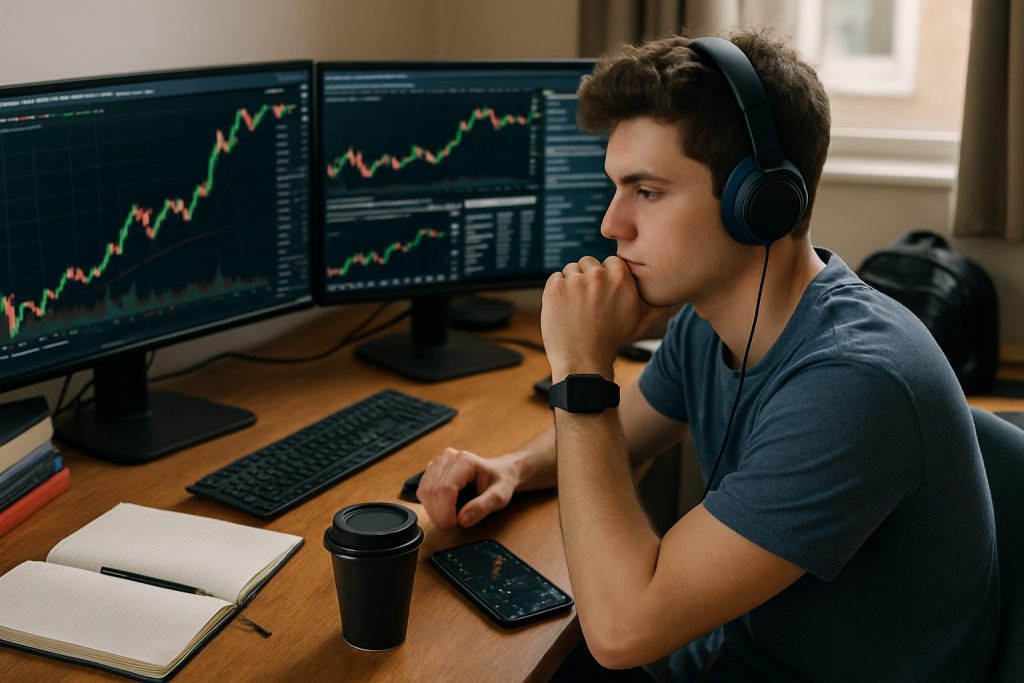
Can students make a career out of day trading? Yes — students can make a career out of day trading, but it requires realistic capital, disciplined practice, and strong risk management to become sustainable.
Students weighing the idea of turning day trading into a career face a sharp trade-off between ambition and reality. Time constraints from classes, limited startup capital, and the emotional toll of intraday volatility all work against instant success. Yet with focused market analysis, deliberate skill-building, and an appreciation for risk management, a student can develop a path that leads either to independent trading or to roles inside finance. Many firms now prize quant skills and practical results, so degrees in mathematics, computer science or economics can accelerate access to institutional opportunities. For those aiming to be independent, a phased plan—paper trading, capital accumulation, strict position sizing, and continuous review—reduces the chance of ruin. The following sections unpack what a realistic trading career looks like for students, the educational and technical foundations that help, and a practical step-by-step plan to start while studying.
Practical reality for students considering a day trading career
Day trading as a student is a high-effort pursuit that can coexist with study only with careful prioritization. The largest hurdles are capital, time for practice, and the psychological strain of losing trades. A clear plan helps separate hopeful hobbyists from those who can genuinely build a career.
Key practical elements every student must evaluate include realistic returns, living costs, and the difference between trading independently and working for a firm. Below is a compact comparison to ground expectations.
| Aspect | Realistic student scenario | What it implies |
|---|---|---|
| Starting capital | $1,000–$20,000 typical for students | Limited capital caps income; focus on skill growth over income |
| Annual return expectation | 5–30% realistic once skilled | Even 10% on $20k is modest—plan supplementary income |
| Time commitment | 1–4 hours/day for part-time; full-time requires 6–10 hours | Balance with studies; consider swing trading if constrained |
- Assess cash needs: know whether trading profits must cover rent or simply be reinvested.
- Paper trade first: simulate real market analysis before risking capital.
- Keep records: track every trade and measure edge and expectancy.
Case study: Maya, a third-year economics student, started with simulated trading, kept a trading journal, and only moved to live trading after a year of consistent positive expectancy; that phased approach protected her studies and savings. The key insight: students can only treat day trading like a career after they prove consistent edge and protect living capital.
Essential education and trading skills for students aiming for a trading career
A targeted skill set shortens the learning curve. Employers and profitable self-employed traders increasingly reward quantitative ability, coding, and disciplined market analysis. Choosing coursework that builds these muscles accelerates progress.
The following table links degree focus to trading roles and the most valuable skills drawn from each field.
| Degree focus | Best-fit trading area | Key skills to develop |
|---|---|---|
| Mathematics / Statistics | Quantitative & algorithmic trading | Probability, statistical modelling, backtesting |
| Computer Science | Algo development & automation | Programming (Python/C++), data pipelines, APIs |
| Economics / Finance | Macro, FX, and discretionary trading | Macro analysis, valuation, economic indicators |
| Engineering / Physics | Quant & systems design | Model building, systems thinking, numerical methods |
- Courses to prioritize: statistics, programming, portfolio theory, econometrics.
- Soft skills: patience, emotional control, record-keeping, and adaptability.
- Practical labs: internships, trading simulations, and coding projects.
Many trading firms now expect demonstrable results or project work; academic credentials open doors but do not replace a proven track record. For students targeting institutional roles, pairing a strong degree with internships creates the strongest path. Insight: education should be chosen to amplify specific trading skills rather than to signal competence alone.
How to start day trading while studying: a practical, staged plan
Starting as a student should be staged, low-risk, and metrics-driven. The plan below reduces downside while building the technical and psychological foundations needed for a career transition later on.
Step-by-step framework to begin trading during university:
| Stage | Duration | Primary goals |
|---|---|---|
| Stage 1: Learn & simulate | 3–6 months | Master platform, backtesting, develop rules |
| Stage 2: Small live account | 6–12 months | Risk |
| Stage 3: Scale & diversify | 12–36 months | Increase capital slowly, add strategies, document edge |
- Start with education: use simulated trading and read about position sizing and risk management; see tax and career implications at tax breaks for full-time day traders.
- Measure everything: keep a trading log; calculate expectancy before scaling.
- Protect capital: set strict stop-losses, set a max daily loss, and avoid emotional revenge trading.
Additional resources and questions students often research include whether day trading is only for professionals (is day trading only for professionals?) and if trading can replace regular income (can day trading replace my regular job?). For those wondering about sustainability and lifestyle, consult is day trading sustainable as a career and real stories about living on trading profits at can you live only from day trading profits. If capital is small, explore whether trading with minimal funds is feasible (examples on small account trading) and avoid shortcuts like untested copy-trading platforms by reviewing copy trading guidance.
Common pitfalls are scaling before consistent edge, letting losses grow, and neglecting taxes and legal considerations; see practical rules about quitting a job for trading (can you quit your job to become a day trader?) and whether trading can fund early retirement (can day trading make you rich enough to retire early?). The stage-gated approach preserves study time while building competence. Final insight: start small, measure performance rigorously, and only scale when statistical edge is confirmed.
Common questions students ask about building a day trading career
How long before a student can expect consistent results?
Consistency typically takes months to years; most students need at least 6–18 months of disciplined practice and strict risk controls before live trading yields repeatable positive expectancy. Persistence, journaling, and iterative improvement are essential.
Is formal education necessary to work in trading firms?
Many firms prefer degrees in finance, mathematics, computer science or similar fields, but documented performance and internship experience can substitute. Academic credentials help open doors, while demonstrated trading skills secure them.
Can trading pay for living expenses as a student?
Generally not at first. With modest capital, even good percentage returns produce limited absolute income. It is safer to use trading profits as supplemental income until capital and consistency support full financial independence.
Should students use copy trading or social trading apps?
Copy trading can offer learning exposure but carries risks of hidden drawdowns and mismatched risk profiles. Beginners should prioritize education and simulated strategies over blindly following others; see guidance on copying at should beginners use copy trading apps.
Is day trading viable alongside a demanding degree?
Yes, if time is managed and trading goals are realistic. For very demanding programs, consider swing trading or systematic strategies that require less intraday attention. The critical element is a structured routine that protects study time while allowing incremental skill development.

With over a decade of experience navigating global financial markets, I specialize in identifying trends and managing risk as a professional trader. My passion for economics drives my daily commitment to staying ahead in this fast-paced industry. Outside of the markets, I enjoy exploring technology like cryptocurrencies and new investment strategies.