
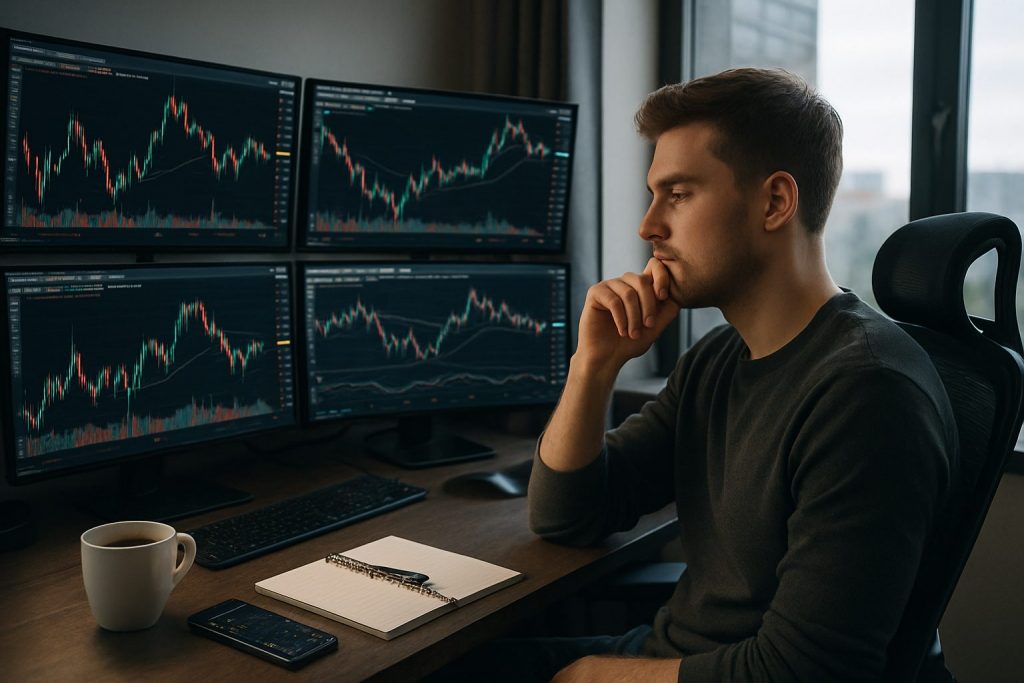
Do I have to trade all day to make money? No — trading all day is not required to make money; focused sessions and disciplined setups can be enough to be profitable.
Day trading does not demand constant screen time to achieve results; what matters is how those trading hours are used. A part-time trader who understands market structure, limits risk, and follows a repeatable investment strategy can earn while maintaining a life outside the screen. Practical examples show traders who trade the first hour of strong market moves, or who focus on a specific session, capture meaningful edges without trading full-time. This guide explains how much time different approaches typically require, how trading hours affect execution and costs, and how to match a strategy to platforms like Pocket Option, Quotex, or Olymp Trade. It also illustrates a simple routine for someone named Alex — a fictional part-time trader — who balances a day job and trading goals to steadily improve profitability. Read on to discover concrete trading tips, typical trading frequency, and how to protect capital while learning to turn day trading into a reliable skill set.
How much time do you need daily for day trading success?
Different trading styles demand different time commitments. A scalper might need several focused hours; a momentum trader often concentrates on the first and last market hours; a pullback trader can scan setups and act during select windows. The right balance depends on the chosen edge, the instrument’s liquidity in the stock market or forex, and the trader’s risk tolerance.
- Micro session (30–90 minutes): suitable for specific strategies like opening-range breakouts or a single news catalyst.
- Part-time window (2–4 hours): common for momentum, pullback, or trend-following strategies during high liquidity periods.
- Full-day (6+ hours): required for high-frequency scalping or active multiple-instrument trading.
| Trading style | Typical daily trading hours | Primary focus | Good for |
|---|---|---|---|
| Scalping | 3–6 hours intensive | Execution speed, tight spreads | Experienced traders with low-cost execution |
| Momentum | 1–3 hours (high-volume windows) | News-driven moves, volume spikes | Part-time traders seeking fast feedback |
| Pullback / Trend following | 1–4 hours (moment selection) | High-probability retraces | Traders valuing higher risk-reward |
| Range trading | 2–4 hours | Support/resistance repeats | Disciplined traders avoiding overnight risk |
- See practical schedules for traders: how many hours a day do day traders work
- Can it fit travel or remote work? Check can day traders work from anywhere
- Want a strict one-hour plan? See can i day trade only 1 hour a day
Insight: choose a time window that aligns with the strategy’s natural liquidity and stick to it — quality beats hours.
Why trading all day is not necessary to make money in financial markets
Trading all day can increase trading frequency and costs without improving the edge. Profitability is tied to a clear investment strategy, disciplined risk management, and execution quality rather than sheer time spent. A trader who overtrades often faces larger spreads, slippage, and emotional mistakes that erode gains.
- Costs grow with frequency: spreads, slippage, and platform fees add up quickly.
- Emotional fatigue: longer trading hours increase impulsive decisions and overtrading.
- Edge dilution: trading outside conditions that favor your setup turns edges into random outcomes.
Example – Alex’s story: Alex trades momentum on certain stocks and focuses only on the first 90 minutes of the session. By restricting trading hours, Alex reduced slippage, lowered costs on Pocket Option and Olymp Trade executions, and improved the signal-to-noise ratio of setups. That discipline turned small session gains into consistent monthly progress.
| Broker | Best for part-time traders | Execution note |
|---|---|---|
| Pocket Option | Binary-style quick setups, simple interface | Good for clear, defined-risk trades |
| Quotex | Flexible session choices, lower minimums | Suitable for selective trading windows |
| Olymp Trade | Charting and risk controls for part-time plans | Strong for disciplined position sizing |
- Research shows a small minority of traders earn consistent profits; time alone is not the driver.
- Align trading hours with strategy strengths — e.g., opening-range breakouts during market open.
- Protect capital by keeping losses small and manageable to survive learning curves.
Insight: spending all day trading is a poor substitute for a repeatable process; selective hours preserve capital and sharpening of skill.
How to structure trading hours and trading frequency for consistent profitability
Design a schedule that matches the chosen strategy, available trading hours, and life commitments. For example, a part-time trader can combine a morning 60–90 minute session for market open volatility and a short review period in the afternoon. That structure keeps trading frequency manageable while providing fast feedback loops needed to learn.
- Set fixed trading windows: e.g., 08:30–10:00 to capture opening moves.
- Limit the number of trades: quality setups only — 1–5 trades per session for many part-time plans.
- Daily review (20–30 minutes): log trades, update the journal, and adjust rules incrementally.
Practical resources: read how traders balance travel with trading at can i day trade while traveling and whether trading on mornings fits lifestyle at can i day trade only in the mornings.
- Use scanners to reduce screen time; let algorithms surface candidate setups during chosen trading hours.
- Place predefined stop-loss and take-profit levels before entry to avoid emotion-driven edits.
- Track metrics: win rate, average winner/loser, risk-reward, and maximum drawdown to assess true profitability.
Insight: a disciplined schedule with limited trading frequency accelerates skill-building and clarifies whether the approach actually produces consistent returns.
Practical trading tips for making money without trading all day
Being deliberate is the core advantage of trading less. A few well-planned trades per day with proper money management often outperform many impulsive trades across long hours. Here are hands-on trading tips to convert short sessions into sustainable gains.
- Pre-define risk per trade: risk 1–2% of capital per trade to survive adverse streaks.
- Master one setup: repetition beats variety when building an edge.
- Use platform risk tools: leverage Pocket Option, Quotex, or Olymp Trade features to preset stops and alerts.
- Automate alerts: scanners notify only when criteria are met, saving time and reducing FOMO.
- Journal every trade: record reasons, emotions, and outcomes to refine the process.
For those wondering about schedule flexibility, see posts about trading while on vacation and 9-to-5 compatibility: can i day trade while on vacation and do day traders work 9 to 5. These resources show many traders keep jobs while learning, using short dedicated trading hours to build skill before increasing size.
- Prioritize execution quality: avoid platforms with lag during key trading hours to reduce slippage.
- Be realistic about passive income expectations — day trading is active and demands skill before it can approach any form of passive return.
- Use small contracts or fractional sizes to practice without risking large capital.
Insight: consistent profitability comes from rules, not hours — disciplined, short, repeatable sessions are a practical path to making money in day trading.
Key resources and extra reading
- Do day traders get job benefits
- How many trades do day traders make per day
- Can I day trade only in the evenings
Insight: continuing education and realistic expectations about trading frequency and costs separate hopefuls from consistent performers.
How many hours per day do most profitable day traders actually trade?
Most profitable day traders trade selective windows — often 1 to 4 hours — focused on high-liquidity periods that match their strategy. What matters more than hours is maintaining a repeatable edge and disciplined risk management.
Can someone make passive income from day trading?
Day trading is active, not passive. Turning it into passive income requires building systems that can be reliably automated or transitioning to income from other investments; initially, active learning and deliberate trading hours are required to develop profitability.
Is trading all day better for learning faster?
More screen time gives more feedback, but without focused review and discipline it accelerates mistakes. Structured repetition with a journal, targeted trading hours, and controlled risk produces better learning per hour than unfocused all-day trading.
Which trading frequency gives the best chance of profitability?
There’s no universal answer; a moderate frequency (few high-quality trades per session) often outperforms high-volume overtrading. Track win rate, average winner/loser, and risk-reward to determine if frequency is helping or hurting profitability.
Which platforms are recommended for part-time traders?
Platforms like Pocket Option, Quotex, and Olymp Trade are often chosen for their ease of use, preset risk controls, and suitability for selective trading windows. Choose a platform that offers reliable execution during your chosen trading hours and clear risk tools.

With over a decade of experience navigating global financial markets, I specialize in identifying trends and managing risk as a professional trader. My passion for economics drives my daily commitment to staying ahead in this fast-paced industry. Outside of the markets, I enjoy exploring technology like cryptocurrencies and new investment strategies.