
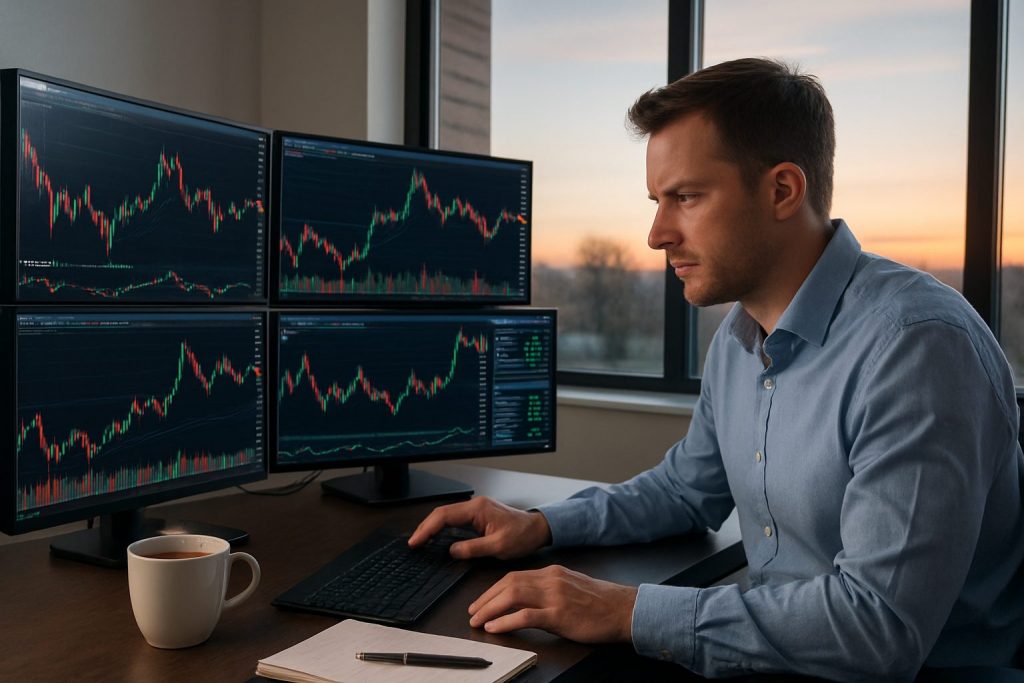
Can I day trade only in the mornings? Yes — day trade only in the mornings is possible, provided a strict morning trading strategy, focused risk controls, and a tailored trading schedule are in place.
Not for US residents.
Morning-only day trading concentrates activity on the market’s most energetic window to capture clean moves and preserve mental energy for the rest of the day. This approach leverages the morning session when market volatility and liquidity are highest, especially in the first hour after the stock market opens. Traders with limited time can adopt a compact trading schedule focused on pre-market scans, execution during the open, and quick journaling. The trade-off: fewer opportunities overall and higher dependence on the accuracy of morning setups. A hypothetical trader, Lena, uses a consistent checklist, limits position size after the open, and treats lunchtime as off-limits to protect gains. Below are practical steps, examples, and tools to build a replicable intraday trading routine that targets the morning.
Why morning-only day trading can work with the right trading strategy
Choosing morning trading concentrates effort where the financial markets often display the largest, most reliable intraday moves. The first hour after open typically reflects overnight news, earnings, and repositioning by institutions, creating tradable volatility.
- Higher liquidity in opening hours reduces slippage on entries and exits.
- Clearer price action helps identify momentum and breakout setups.
- Shorter screen time reduces cognitive fatigue and impulsive trading.
Example: Lena scans pre-market movers, builds a tight watchlist, takes 1–3 high-probability trades in the first hour, then journals. This routine emphasizes quality over quantity and protects capital.
- Pre-market scan: find news-driven gappers and check volume patterns.
- Execution: use limit orders near defined support/resistance.
- Risk control: fixed % per trade and hard daily loss limit.
Key insight: a disciplined morning plan converts limited hours into a sustainable edge.
Common pitfalls in morning-only intraday trading
Morning trading is not immune to mistakes. Low-quality execution or overtrading can erase gains quickly. Weekend news can create unpredictable gaps, and some days simply lack setups.
- Overtrading due to FOMO after a losing trade.
- Failure to adapt during quiet mornings with low volatility.
- Ignoring macro events that can spike volatility unexpectedly.
Practical fix: maintain a pre-market checklist and keep a trading schedule that enforces breaks and journaling.
How to design a morning trading schedule and the best trading hours to target
Designing a morning-only routine means mapping precise blocks of time to tasks. The most productive schedule focuses on pre-market preparation, the opening hour, and a short post-open review.
- Pre-market (30–90 min): scan, set alerts, update watchlist.
- Market open (first 60–90 min): active execution window for setups.
- Quick review (10–20 min): log trades, note lessons, and stop for the day.
| Time Block (ET) | Goal | What to watch |
|---|---|---|
| 8:00–9:00 | Pre-market research | News catalysts, gappers, pre-market volume |
| 9:30–10:30 | Active trading | Opening range, momentum breakouts, liquidity |
| 10:30–11:00 | Quick review | Journal trades, update watchlist, stop for day |
Time-zone note: traders on Pacific Time should start earlier; adapt the schedule to local hours but keep the same structure. For travelers or part-timers, targeted morning sessions can still be effective—see resources on trading while traveling or trading part-time.
- Adjust local hours to catch the market open in the chosen venue.
- Use demo accounts to test morning-only rules before committing real capital.
- Limit the number of trades to maintain edge and reduce emotional trading.
Related reading: strategies for pre-market scanning and after-hours considerations can improve the morning plan — see further resources on pre-market trading and after-hours trading.
Tools, preparation and rules that make morning trading repeatable
The right tools streamline decisions and prevent mistakes. Essential elements include fast charts, reliable news sources, and a simple checklist. Lena keeps a one-page morning playbook pinned to the desk.
- Real-time news feeds for overnight catalysts — see why news feeds matter.
- Scanners or filters to highlight gappers and high-volume movers.
- Demo practice to refine entries and exits without emotional pressure.
Useful resources and deeper dives: consider articles on whether AI tools help day trading, if paid scanners are necessary, or how to trade while traveling.
Final practice tip before the FAQ: track every trade and analyze performance by hour. Over time, the data will show whether morning-only day trading truly fits the trader’s edge and lifestyle.
| Advantage | Trade-off |
|---|---|
| Concentrated volatility = fewer, clearer setups | Missed opportunities in later sessions |
| Lower screen time, better focus | Higher reliance on accuracy of morning decisions |
Helpful links to explore more practical questions and tools:
- Can I day trade pre-market?
- Can I day trade after-hours?
- Do I need news feeds for day trading?
- Do I need paid scanners for day trading?
- Do I need AI tools for day trading?
- Can I day trade while traveling?
Note: The resources above offer practical perspectives on tools, mobility, and part-time setups that complement a morning-only approach.
Insight: Morning-only day trading demands consistent routines, tight risk controls, and honest review; when those are in place, the morning can be a highly productive trading environment.
Quick checklist for a morning-only day trading session
- Pre-market: check news, set watchlist, size positions.
- Open: focus on top 1–3 setups, use defined stop-losses.
- Post-open: journal, log P/L, and stop for the day.
Practical further reading on lifestyle and scheduling: Do day traders work 9-to-5? and Can day trading be done part-time while working?
Closing section insight: Morning-only trading fits many traders who value structure and limited screen time; it is a realistic path when backed by preparation and disciplined execution.
Will using minimal hardware work for morning trading? See: Is a cheap Windows laptop good enough for day trading?
Questions traders often ask
Can day trading only in the mornings be profitable long term?
Yes — profitability depends on consistent edge, disciplined risk management, and recording performance by time of day to confirm the edge.
What if there are no setups during the morning session?
Skip trading. Preserving capital is itself a strategy; use the time to analyze and refine the watchlist.
How many trades should a morning-only trader take?
Quality over quantity: often 1–5 high-conviction trades in the opening hour, depending on the setup and risk tolerance.
Can morning-only day traders use pre-market data effectively?
Yes — pre-market scans help build the watchlist and anticipate opening range behavior; combine with reliable news feeds for context.
Is it better to trade the open or the power hour if only one is possible?
The open usually offers cleaner, larger moves for most intraday strategies; the close (power hour) can be used selectively if the trader prefers end-of-day volatility.

With over a decade of experience navigating global financial markets, I specialize in identifying trends and managing risk as a professional trader. My passion for economics drives my daily commitment to staying ahead in this fast-paced industry. Outside of the markets, I enjoy exploring technology like cryptocurrencies and new investment strategies.