
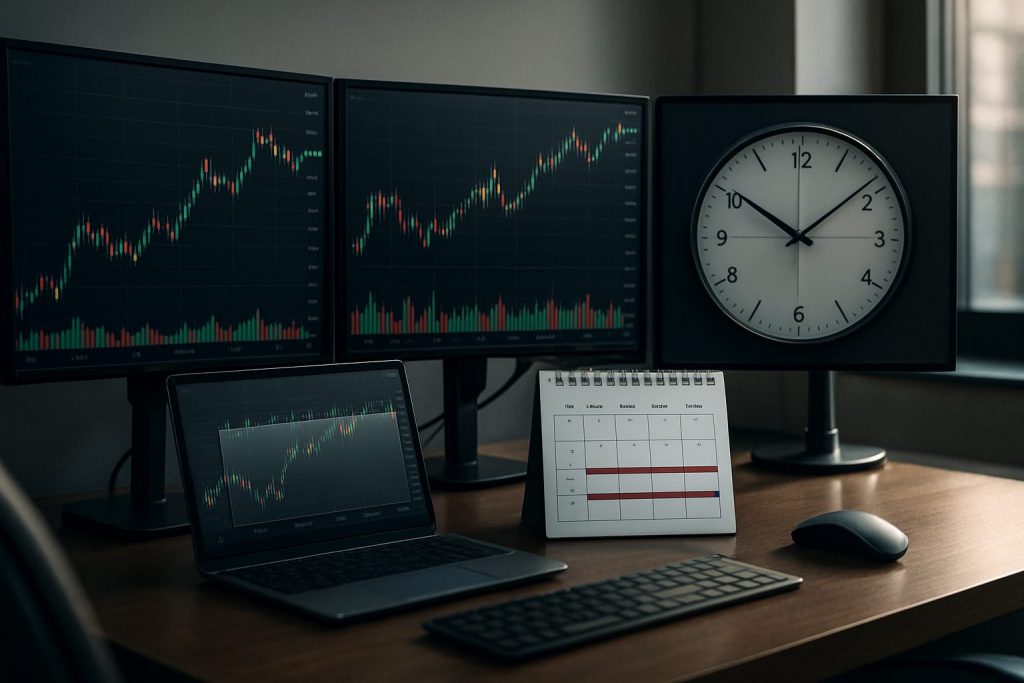
Are there time restrictions on day trading? Yes — day trading commonly faces time restrictions tied to exchange trading hours, broker session limits and the liquidity window between market open and market close.
Fast-paced and often unforgiving, day trading depends as much on timing as on strategy. Traders must navigate exchange-specific trading hours, broker-imposed session limits and clearing/settlement rules that constrain when trades can open and close. Across global markets, intraday liquidity peaks near the market open and before the market close, while pre-market and after-hours sessions exist but carry higher spreads and fewer counterparties. Local trading regulations and account types (cash vs margin) also shape how many round-trip trades a retail investor can place in a short window. Consider the profile of a fictional trader, Anna, who uses short-lived setups: her success depends on aligning strategy, trade timing and platform rules — not only on analysis. For newcomers, understanding session boundaries and broker policies is the first step toward responsible intraday trading.
Trading hours and session limits that shape day trading
Different instruments and exchanges define when intraday activity is possible. The most explicit time restrictions come from exchange calendars and broker platforms — they set the accepted trading hours, define market open and market close, and may open limited pre/post sessions.
- Exchange calendars determine official session start and end times.
- Brokers may permit pre-market and after-hours trading but with limits.
- Some jurisdictions impose additional rules that affect intraday execution.
| Market / Instrument | Typical session | Common session notes |
|---|---|---|
| Stock market | Regular session (e.g., 09:30–16:00 local exchange) | High liquidity at market open and near market close; pre/post sessions exist with higher spreads. |
| Futures | Nearly 24h with maintenance breaks | Overnight sessions trade but volume concentrates during core session; exchange maintenance windows impose hard breaks. |
| Forex | 24/5 continuous sessions | Session overlaps (e.g., London/New York) create peak liquidity windows for intraday setups. |
| Crypto | 24/7 continuous | No official market open or market close, but platforms may apply withdrawal or maintenance windows. |
Key insight: knowing the active session for the chosen instrument defines the practical window for executing reliable intraday trades.
How broker rules and trading regulations affect intraday trading
Beyond exchange hours, brokers and regulators enforce rules that limit frequency and timing of trades. These are aspects of trading regulations that protect liquidity and limit excessive leverage.
- Account type: cash accounts restrict using unsettled funds, limiting rapid round-trips.
- Margin rules: brokers may cap leverage during certain sessions or for new accounts.
- Platform-specific session limits: some brokers restrict how many trades can be opened in a short span.
| Constraint | Effect on day trading |
|---|---|
| Cash settlement | Limits intraday trades to settled funds; trade timing must account for T+ settlement cycles. |
| Broker session limits | Can restrict number of intraday trades or access to pre/post markets. |
| Regulatory monitoring | Surveillance systems flag suspicious patterns; repeated violations can lead to account restrictions. |
Practical tip: verify platform rules and local trading regulations before designing intraday strategies — Anna always checks her broker’s policy on settled funds and session access.
Practical trade timing: intraday structure and risk controls
Effective trade timing requires aligning setup strength with session liquidity. A disciplined approach reduces slippage and widens the edge for short-lived trades.
- Target high-liquidity windows around the market open and the last hour before market close.
- Use session-specific position sizing and tighter risk controls during thinly traded periods.
- Plan for platform maintenance windows and settlement delays that interrupt intraday flows.
| Session | Trading approach |
|---|---|
| Market open | Scalp or momentum trades; expect volatility and wider spreads but strong volume. |
| Mid-session | Range or mean-reversion strategies; watch for thin liquidity. |
| Market close | Position flattening and end-of-day trend plays; liquidity often spikes again. |
Anna’s insight: adapt position size and stop placement to session conditions — rigid rules for risk management beat chasing every intraday signal.
How to navigate common questions about session limits and trade frequency
Several practical questions often determine whether a trader can operate freely across intraday windows. Read platform docs and regulatory summaries linked below for jurisdiction-specific details.
- Check whether a cash account or margin account is in use — this alters allowed trade frequency.
- Confirm broker pre/post-market availability and any special margin calls during volatile sessions.
- Understand local tax treatment and reporting obligations for frequent trades.
Useful resources and deeper reads: explore articles about legality and rules, such as is day trading legal, how many trades can I make per day, and guidance on using cash accounts to avoid certain rules at can I avoid the PDT rule by trading cash accounts.
Additional reading on related constraints: margin and asset-specific rules like futures and crypto are discussed at PDT and futures and PDT and crypto.
Final insight for this section: a clear checklist of account type, exchange hours and broker policies prevents unexpected session-related limitations.
Resources on taxes, student traders and strategy tools
Tax status, professional trader designation and special cases like student traders all change obligations and permitted trade behavior. Read deeper analyses for specific scenarios and jurisdictions.
- Tax treatment of intraday profits and whether they are treated as income or capital gains — see detailed overview.
- Student-specific guidance on legality and account rules: can students day trade legally.
- Consider whether copy trading is suitable for beginners: copy trading pros & cons.
Key takeaway: tax and eligibility rules are as important as session mechanics; plan trade timing with both in mind.
Questions traders frequently ask
Below are concise answers to common concerns about day trading and trade timing.
- Can settlement rules stop intraday trading? Yes — cash accounts rely on settled funds and settlement cycles can limit the number of quick round-trip trades.
- Do brokers limit trades per session? Many do — platforms can enforce session limits, margin caps or require verification for high-frequency activity.
- Are pre/post-market trades equivalent to regular session trades? No — they often have less liquidity, wider spreads and higher execution risk.
Anna’s closing thought for this part: align the strategy to the session that best supports it — timing is as decisive as edge.
Further reading on taxation and international differences
Regulatory landscapes differ worldwide. For those comparing cross-border rules, articles such as how are day trading profits taxed in Canada and jurisdictional rule summaries can clarify local constraints.
- Compare local tax treatment and reporting windows before increasing intraday volume.
- Check broker notices for country-specific session limits and leverage caps.
- Use reliable resources and consult professionals when in doubt about legal status or tax implications.
Insight: international differences mean one trader’s freedom in one market may be another’s strict limit elsewhere.
Closing practical checklist
- Verify exchange trading hours and maintenance breaks for chosen instruments.
- Confirm broker rules on margin, cash settlement and session access.
- Plan trades around high-liquidity windows and manage size per session risk.
Before increasing intraday activity, test strategies in real session conditions and document how trade timing affects outcomes.
Common questions and answers
Are there fixed global time limits that stop intraday trading?
No — there are no single global time limits; limits are exchange- and broker-specific. Instruments like forex and crypto trade nearly continuously, while stock markets have defined market open and market close times.
Can a trader avoid platform session restrictions by switching account types?
Sometimes — switching between cash and margin accounts changes settlement and leverage rules. Refer to platform policies such as whether trading on a cash account allows more flexibility at can I avoid the PDT rule by trading cash accounts.
How do regulations affect intraday leverage and frequency?
Regulatory bodies enforce margin and pattern rules that limit high-frequency intraday trades. Local guidance and broker terms detail these constraints; see deeper context at is day trading legal.
Are taxes different for active intraday traders?
Yes — taxation varies by jurisdiction and by whether trading qualifies as a business. For example, see guides on taxation differences and professional classification at tax breaks for full-time day traders.
Where to learn more about trade frequency limits?
Explore articles on allowed trade counts and practical limits like how many trades can I make per day.

With over a decade of experience navigating global financial markets, I specialize in identifying trends and managing risk as a professional trader. My passion for economics drives my daily commitment to staying ahead in this fast-paced industry. Outside of the markets, I enjoy exploring technology like cryptocurrencies and new investment strategies.