
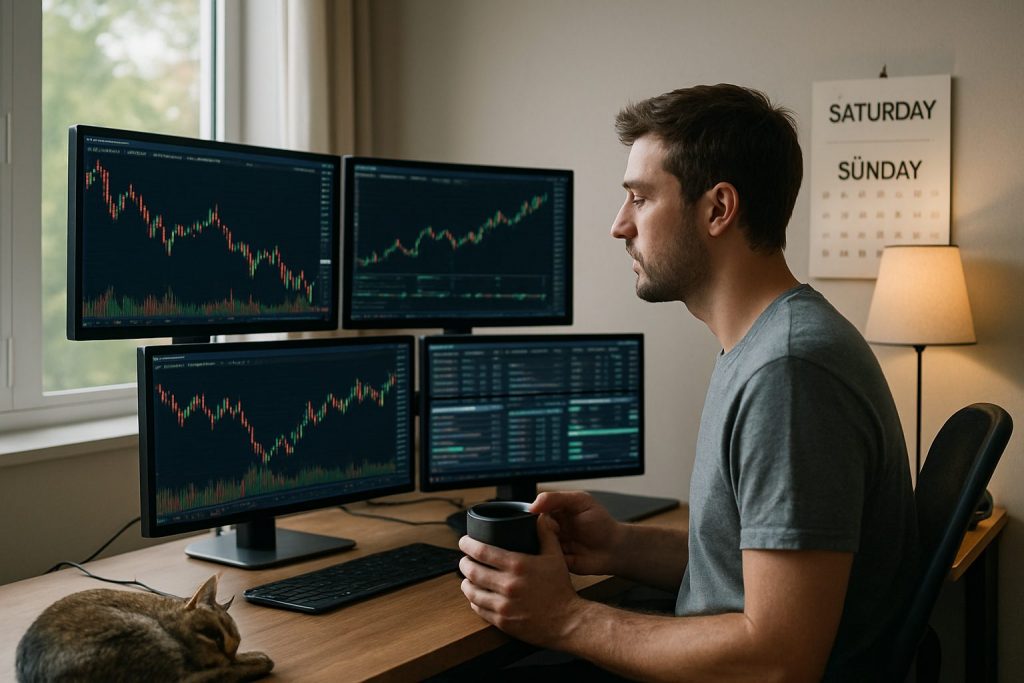
Can I day trade on weekends? Yes — you can day trade on weekends depending on the market and the trading platform you use.
Weekend trading is increasingly available to retail traders who seek flexibility beyond traditional trading hours. While the major stock market cash sessions close for the weekend, other corners of the financial markets remain live: cryptocurrencies trade 24/7, some brokers offer synthetic or OTC weekend markets for currency trading and indices, and platforms such as Pocket Option, Quotex and Olymp Trade provide specific weekend instruments. Weekend sessions carry unique dynamics — thinner liquidity, wider spreads and a higher sensitivity to geopolitical news — so eligible traders should practice on demo accounts, adapt position sizing and prepare tailored strategies. This guide explains which instruments actually trade on Saturdays and Sundays, how trading hours and market closure rules affect execution, a practical checklist to start weekend day trading on the allowed platforms, concrete risk rules, and targeted strategies that fit low-volume sessions. The aim is to help new traders convert weekend time into disciplined, lower-impact trading practice without confusing weekday rules with weekend realities.
Can you day trade on weekends? Quick rules about weekend trading hours
Weekend trading depends on the instrument: the stock market cash sessions are usually closed, while cryptocurrencies and some broker-offered OTC instruments remain tradable. Below are the core rules to remember.
- Stock market closure: Major exchanges do not execute normal cash trades on Saturdays and Sundays.
- Crypto 24/7: Bitcoin and most major altcoins trade nonstop, so weekend activity is common.
- Broker weekend windows: Some trading platforms create weekend markets or OTC quotes for indices, commodities or currency trading.
- Execution risks: Expect wider spreads, potential slippage and lower depth of market on weekend sessions.
Key insight: treat weekend trading as a different market environment with its own trading hours and execution rules, and always confirm the platform’s weekend schedule before placing orders.
Short video primer on weekend trading essentials
Watch a short explainer that clarifies why weekend markets behave differently and what to test on demo first.
Which markets are actually open on weekends and how market closure changes liquidity
Not all asset classes are equal when it comes to weekend trading. Understanding which instruments are live and why liquidity differs is central to a safe approach.
- Cryptocurrencies: Continuously tradable on most platforms — high volatility but predictable 24/7 access.
- Broker OTC / weekend CFDs: Platforms such as Pocket Option, Quotex and Olymp Trade may offer synthetic weekend quotes for indices, commodities and FX-like pairs.
- Stock indices vs cash shares: Index derivatives can appear on weekends via brokers, but individual equities on major exchanges remain closed.
- Currency trading: True interbank FX runs Monday–Friday; weekend FX-like products on retail platforms are synthetic and often wider spread.
| Asset class | Typical weekend availability | What to expect (liquidity & spreads) |
|---|---|---|
| Cryptocurrencies | 24/7 on most trading platforms | Active volume; high volatility; normal retail access |
| Indices (OTC via brokers) | Often available on Pocket Option / Quotex / Olymp Trade | Lower depth; wider spreads; synthetic pricing |
| Individual Stocks | Usually closed (cash markets) | No regular trading; only broker-created derivatives if offered |
| Currency trading (FX) | Interbank closed; some brokers offer weekend quotes | Very thin liquidity; expect larger bid-ask spreads |
Example: a trader who prefers technical setups may use crypto pairs on Saturday because trading platforms provide continuous charts, whereas weekend FX provided by a broker is best treated like a different instrument, not as a mirror of Monday interbank pricing.
How to start weekend day trading on Pocket Option, Quotex and Olymp Trade
For non-US residents aiming to use weekend sessions productively, these three platforms are commonly used by retail weekend traders. Start with a structured onboarding process and demo testing.
- Create demo accounts on the chosen platform and simulate weekend orders to observe spreads and execution.
- Verify tradable lists — check each platform’s instrument list for Saturday and Sunday availability.
- Set conservative sizing — reduce position sizes compared with weekday norms due to slippage risk.
- Practice specific strategies (range, mean-reversion, gap-close) under weekend conditions on demo first.
- Confirm support hours — know when customer service is reachable on the weekend for trade disputes.
Practical checklist to open a weekend account:
- Open a demo account on Pocket Option, Quotex or Olymp Trade.
- Find the weekend instruments list and check trading hours for each symbol.
- Run at least 30 demo trades over a weekend to measure average spread and slippage.
- Create a weekend-specific trading plan (entry rules, stop distance, profit target).
Key insight: the safest path is practice-first — use demo accounts on the recommended platforms and treat weekend markets as separate instruments with tailored rules.
Risk management and weekend strategies that fit low-liquidity sessions
Weekend day trading demands stricter risk controls. Below are concrete rules, example position sizing, and practical strategies adapted to weekend conditions.
- Smaller risk per trade: reduce risk percentage compared to weekday trades.
- Avoid high leverage: synthetic weekend markets magnify slippage risk.
- Plan for weekend news: avoid exposure before known geopolitical events that can trigger gaps.
- Use wider, sensible stops: account for weekend noise; avoid tiny stops that get eaten by spread.
| Account size | Recommended max risk per trade | Suggested stop distance (weekend) |
|---|---|---|
| €500 | 1%–2% (€5–€10) | 2%–4% market move |
| €1,000 | 1%–2% (€10–€20) | 1.5%–3% market move |
| €5,000+ | 0.5%–1% (€25–€50) | 1%–2% market move |
Weekend strategy examples:
- Gap-close play (crypto or weekend indices): if an overnight jump lacks follow-through, trade toward the prior range with a measured stop.
- Bollinger-band mean-reversion: use wider bands to capture reversion in low-volume ranges on weekend charts.
- Small scalps during overlap hours: trade when multiple time zones are active to gain better liquidity.
Worked example on Pocket Option (binary-style or CFD setups vary): staking €100 on a directional binary-style weekend crypto trade with an 85% payout yields an €85 profit if the prediction is correct, but the entire stake can be lost on a wrong call. For CFD-style trades, use stop-loss to limit risk to the percentages shown above.
For traders who wonder about tax, age and account rules when starting to day trade (including weekends), see practical resources on taxation, deductions and minor accounts: do I have to pay taxes if I lose money day trading, can I deduct day trading losses from my taxes, and can I practice day trading under 18 with a demo account.
Key insight: weekend trades are higher-risk per unit of exposure — keep positions small, avoid leverage, and document every trade to refine weekend-specific rules.
Practical habits, planning and resources for weekend traders
Successful weekend traders pair active sessions with preparatory work. Build habits that use the extra time well.
- Pre-weekend scan: check global event calendars and mark potential risk windows.
- Demo rehearsal: run weekend setups on Pocket Option, Quotex or Olymp Trade before committing live funds.
- Review & journal: use quieter weekend hours to analyze prior trades and adjust strategy.
- Legal & tax checks: consult local rules — see also do I need to report day trading every year and the questions on business registration: sole proprietor or LLC.
Insight: Weekends allow focused study and low-pressure practice — use them to strengthen discipline, not to chase risky, high-leverage quick wins.
Embedding customer support and trading hours checks
Always verify the platform’s weekend trading hours and support availability. For platform-specific time rules and account questions see resources such as are there time restrictions on day trading and can a minor open a day trading account.
- Confirm which assets are marked as OTC or weekend-only on the platform.
- Test order types and stops on demo to see practical execution behavior.
- Keep contact details for weekend support in case of execution disputes.
Final insight for this section: preparation beats impulse — weekend trading rewards thoughtful routines and reliable platform checks.
Can I day trade on weekends? — yes, but it requires different rules, smaller risk and platform-specific checks; practice on demo with Pocket Option, Quotex or Olymp Trade before using real funds.
Questions and answers
Can weekend trading trigger special tax obligations? Weekend activity is treated like any other trading for tax purposes; for details on loss deductions and reporting consult can I deduct day trading losses from my taxes and do I need to report day trading every year.
Is it legal for minors to practice day trading on weekends? Minors cannot open standard live accounts in many jurisdictions, but demo accounts are suitable; see can I practice day trading under 18 with a demo account for guidance.
Do pattern-day-trader rules apply to weekend trades? Pattern-day-trader rules apply to margin equity accounts under the jurisdiction that enforces them; when using non-US platforms for weekend trading, check local margin rules and platform terms — a helpful start is are there time restrictions on day trading.
Should weekend trading use the same strategy as weekday trading? No — adapt strategy to lower liquidity and wider spreads. Use range, mean-reversion or gap-close tactics with smaller sizing and wider stops.
Is registration as a business necessary for weekend trading? It depends on scale and tax rules in your country; explore options such as registering as a sole proprietor or an LLC at sole proprietor or LLC.

With over a decade of experience navigating global financial markets, I specialize in identifying trends and managing risk as a professional trader. My passion for economics drives my daily commitment to staying ahead in this fast-paced industry. Outside of the markets, I enjoy exploring technology like cryptocurrencies and new investment strategies.