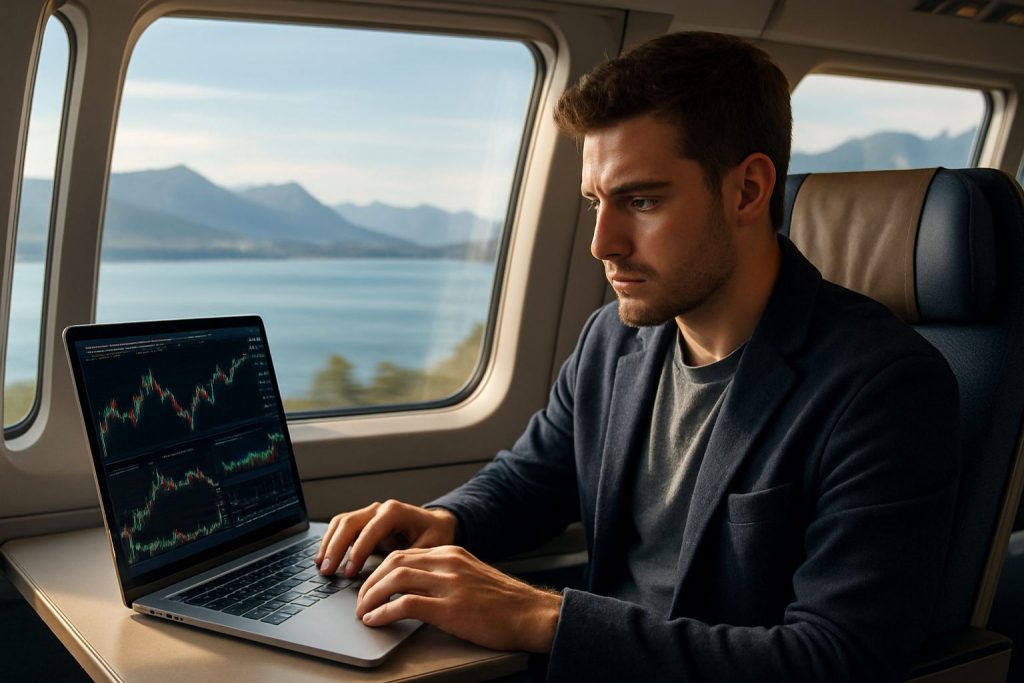
Can I day trade while traveling? Yes — day trade while traveling is possible with preparation, a reliable internet connection, and disciplined routines that fit changing time zones.
Maya, a pragmatic trader who likes to explore new towns between sessions, proves that freedom and focus can coexist: with the right kit, clear rules and modest position sizing, remote trading becomes a sustainable way to participate in the financial markets while on the move. Travel does not mean trading chaos — it demands a compact setup, backups, and the willingness to trade smaller or at different hours. Planning includes knowing how to use trading apps, when to rely on automation, and how to convert sightseeing time into productive breaks. The story that follows explains practical gear, simple schedules for different time zone scenarios, and risk rules for trading on the go, so a trader can enjoy new places without sacrificing capital or sanity.
Essential kit and connectivity for day trading while traveling
A reliable setup is the backbone of any successful attempt to day trade while traveling. It’s not about the most expensive hardware but about having the right combination of portability, redundancy, and secure access to trading platforms and trading apps.
- Primary laptop with decent GPU/CPU for charts and platform stability.
- Portable external monitors or an efficient single-screen layout for mobile trading.
- Multiple internet options: wired where possible, mobile hotspot as backup.
- Power backups and international adapters to avoid surprises.
- Secure VPN and strong device security to protect account access.
| Item | Why it matters | Quick resource |
|---|---|---|
| Laptop or tablet | Runs platforms and mobile trading apps; portability is key. | Is a MacBook good for day trading? |
| External monitors | Improves situational awareness when watching multiple charts. | Do I need multiple monitors for day trading? |
| Primary internet + backup | Prevents disconnects during active trades; redundancy reduces risk. | Do I need high-speed internet for day trading? / How fast should my internet be? |
| Secondary device | Phone or tablet for trade checks and quick adjustments. | Is an iPad good enough for day trading? |
| Backup computer | Critical if the primary machine fails or is lost/stolen. | Do I need a backup computer for day trading? |
Practical anecdote: Maya once relied on a single café Wi‑Fi and lost internet during a market move; since then she always carries a local SIM and a power bank as a minimum. The key insight: redundancy beats speed.
Scheduling, time zones and routines for remote trading
Trading while traveling requires aligning personal rhythms with market hours; discipline replaces proximity to an office. Successful mobile traders build a small, repeatable routine tuned to the market windows they trade and the local time zone where they are staying.
- Fix a primary trading window tied to market activity — many traders favor the first hours of the session.
- Use alerts and automation to reduce screen time and react only to key events.
- Plan sightseeing outside trading hours to preserve mental clarity.
| Travel location (example) | Local time vs market open | Suggested approach |
|---|---|---|
| Europe (Central Europe) | Market opening may coincide with afternoon local time. | Trade morning market open; shift schedule or trade shorter sessions. |
| Asia (Southeast Asia) | Market open often falls overnight local time. | Adjust sleep schedule or use automation and alerts for overnight events. |
| Latin America | Market open often strikes early morning local time. | Early starts are manageable; secure quiet workspace in advance. |
Practical example: Maya schedules her main session for the first market hour and uses tighter stop rules while sightseeing. For traders using trading apps, setting price alerts and conditional orders lets them stay present while traveling. The insight: structure your day first, travel second.
Risk management, mindset and rules for trading on the go
Emotional control and simple rules protect capital when surroundings change; remote trading adds sensory distractions that can erode discipline. Treat every travel day like a test of the system — if the conditions are imperfect, trade smaller or step away.
- Limit position size to reduce stress and slippage risk.
- Use stop losses and pre-defined exit plans; avoid ad-hoc decisions.
- Automate where possible: conditional orders, alerts, and small algorithmic rules.
| Rule | Action | Benefit |
|---|---|---|
| Position caps | Reduce maximum allowable exposure by a fixed percentage while traveling. | Limits emotional leverage and potential losses. |
| Pre-market prep | Scan news and set alerts before the session starts. | Prevents being surprised by major events during travel activities. |
| Backup plan | Know how to place trades by phone and share emergency contacts with broker support. | Mitigates tech failures and connectivity drops. |
Example case: After a headset failure during a volatile session, Maya switched to pre-set orders and reduced size — the trade closed safely, allowing the rest of the trip to continue. The final insight for this section: risk rules are your travel passport — never leave them at home.
Common questions about day trading while traveling
Do portable monitors and a laptop really matter for mobile day trading?
Yes. Portable monitors and a reliable laptop improve situational awareness and allow the use of multiple charts. For reading on setup options see do-i-need-multiple-monitors-for-day-trading and assess whether a tablet suits your style at is-an-ipad-good-enough-for-day-trading.
How fast and stable must the internet be for day trading on the go?
A stable connection is more important than top speed; consistent latency and redundancy matter most. Practical references: do-i-need-high-speed-internet-for-day-trading and how-fast-should-my-internet-be-for-day-trading explain benchmarks and backup strategies.
Is it safe to rely on a single device or should a traveling trader carry backups?
Always carry at least one backup device and power source. See the pros and cons of backups at do-i-need-a-backup-computer-for-day-trading. Redundancy reduces anxiety and prevents forced exits due to tech failures.
Can mobile trading apps replace a full desktop platform when traveling?
Mobile apps are excellent for monitoring, alerts, and quick adjustments, but they rarely replace a multi-chart desktop setup for active intraday strategies. Use apps for situational awareness and pre-set orders, and ensure familiarity by testing them before travel.
Should strategy or timeframe change while traveling?
Often yes: shorter focus windows or switching to higher timeframes can lower stress while traveling. Consider adopting swing-style or longer intraday trades during busy travel periods to reduce screen dependency.

With over a decade of experience navigating global financial markets, I specialize in identifying trends and managing risk as a professional trader. My passion for economics drives my daily commitment to staying ahead in this fast-paced industry. Outside of the markets, I enjoy exploring technology like cryptocurrencies and new investment strategies.