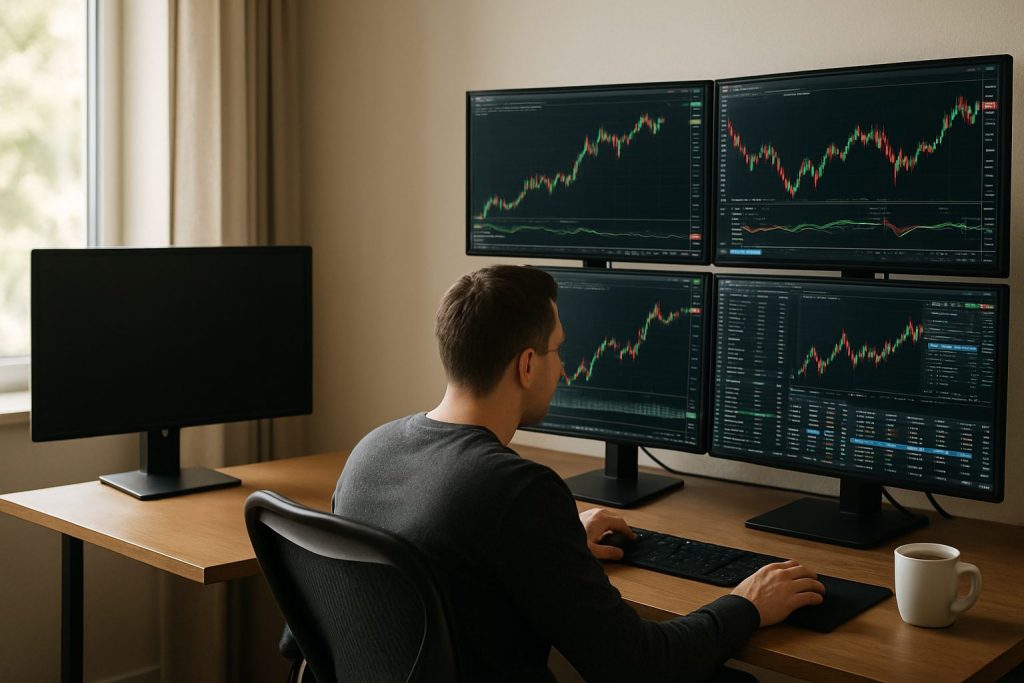
Do I need multiple monitors for day trading? Not necessarily — multiple monitors can boost trading efficiency and screen real estate, but a single, well-organized trading setup can be perfectly adequate for many traders.
The trading floor feel can be recreated at home without buying screens by default. In fast-paced sessions, extra displays speed up market analysis, let traders keep order tickets, charts and news visible, and reduce window-switching that kills focus. Yet the real edge comes from how the workspace is organized: a focused layout, reliable power, and the right trading tools matter more than raw monitor count. This overview compares single- and multi-monitor paths, highlights ergonomic and infrastructure needs for 2026-style setups, and gives concrete, budget-graded recommendations for anyone starting with brokers such as Pocket Option, Quotex, or Olymp Trade. Practical examples show how a retail forex trader named Alex scales a setup from one screen to a multi-screen command center while preserving comfort, minimizing cable chaos, and protecting connection uptime. Readers will leave with clear next steps to improve trading productivity and align hardware with their chosen investment strategies.
How many monitors for day trading: single screen, dual, or multi-screen setups for day trading
Choosing between one, two, or many displays depends on trading style. Scalpers and active intraday traders often prefer more displays to monitor several timeframes and order books. Swing or position traders may find one screen plus a tablet or laptop enough.
- Single screen — suits focused traders using one platform and a compact set of charts.
- Dual monitors — a common sweet spot that separates execution windows from live charts.
- 4+ monitors — for heavy market analysis, news feeds, and multi-asset monitoring.
Example: Alex, a retail forex trader, began with a single 27″ 1440p monitor for price action charts. As strategies moved to include economic news and correlation checks, a second monitor cut reaction time and improved trade decision clarity.
Key considerations to choose a path:
- Trading style — quick-entry strategies favor more screen real estate.
- Budget and desk space — physical footprint and cost scale quickly with extra monitors.
- Hardware capability — ensure GPU and ports can drive multiple displays.
| Setup | Typical monitor count | Best for | Key trade-off |
|---|---|---|---|
| Entry-Level | 1 – 2 | Beginner day traders, swing traders | Lower cost, less instant data |
| Professional | 4 – 6 | Active day traders, multiple instruments | Higher power & desk requirements |
| Elite | 8+ or dual ultrawides | Institutional-style watchrooms | Complex setup, heavy infrastructure |
For day traders, the practical takeaway is to match monitor count to the cognitive load required by the chosen strategy. A modest upgrade often yields the biggest gains in trading productivity.
Ergonomics and desk choices for a multi-monitor trading setup
Ergonomics shapes long-term performance. Poor posture and bad mounting choices create fatigue that erodes edge over months. The right desk and monitor arrangement preserve attention and reaction speed.
- L-shaped desks increase usable surface and support the “reach zone” needed for many displays.
- Weight capacity — choose desks rated beyond the total equipment weight to avoid sagging.
- Golden Arc — arrange monitors in a shallow semi-circle to minimize head rotation.
Practical ergonomics rules:
- Top of primary monitor at or slightly below eye level.
- Lower row angled up slightly, upper row angled down.
- Alternate between sitting and standing to reduce strain.
Alex upgraded to a steel-reinforced L-shaped desk and monitor arms, distributing the weight and eliminating wobble. The insight: invest in structural integrity first to avoid repeated hardware shifts later.
Power, cables, and technical infrastructure to sustain multi-monitor trading
Reliable power and tidy cabling are not luxuries — they protect positions and reduce downtime. A professional-grade station frequently exceeds 20 cables and draws substantial power during high-refresh trading sessions.
- UPS (Uninterruptible Power Supply) — provides a buffer to close positions during outages.
- Dedicated circuits — reduces breaker trips in heavy setups.
- Cable management — under-desk trays, J-channels and reinforcement plates prevent heat and accidental disconnects.
Concrete example: a six-monitor station with a high-end GPU and peripherals may pull significant wattage; installing a 1500VA UPS plus a dedicated 20-amp circuit reduces the chance of losing connectivity during volatile news events.
Final insight: treat power and cabling as part of the trading toolkit — it directly affects trading efficiency and uptime.
Practical recommendations and steps for traders using Pocket Option, Quotex, or Olymp Trade
Choosing hardware should align with platform use and personal routine. The following checklist helps traders scale from one screen to a resilient multi-monitor command center while keeping costs and ergonomics in balance.
- Start with one quality monitor and refine chart layouts on your chosen platform (Pocket Option, Quotex, or Olymp Trade).
- Add a second screen for execution and confirmation windows before expanding further.
- When adding more monitors, prioritize arm mounts, desk reinforcement, and a UPS.
Useful learning links and setup guides:
- Can I day trade on a laptop? — helps decide if a laptop can be the primary machine while monitoring additional screens.
- Do I need a desktop PC to day trade? — explains GPU and port demands for multi-monitor arrays.
- Do I need a professional platform to start day trading? — evaluates whether platform features justify extra screens.
- Repeat reference for planning: Desktop vs laptop considerations.
- Further reading: Laptop trading and second-screen workflows.
When testing a change, simulate live conditions: run the platform, news feed, and order flow for a full session. The insight: incremental upgrades tied to real trading needs produce the best improvements in trading productivity.
Key quick checklist
- Test hardware on the actual trading platform (Pocket Option, Quotex, Olymp Trade).
- Validate desk load and monitor mount compatibility.
- Install UPS and set up basic cable management before live trading.
Investment strategies and monitor count — match the tools to the plan
Day traders who run multiple correlated strategies need broader visibility. For buy-and-hold or longer-term setups, fewer monitors plus remote alerts are usually enough.
- High-frequency or scalping strategies benefit from multiple monitors showing order books, time & sales, and several timeframes.
- Portfolio or swing approaches prioritize a clean, distraction-free workspace with selective additional screens for news.
Final insight: strategy dictates screen needs; avoid buying displays for the perceived prestige of a multi-monitor command center.
Alex’s closing note: scaling should be deliberate — each added screen must solve a workflow problem, not create a new one.
Resources and visuals
Explore setup ideas and ergonomics before buying. Test any configuration in a non-live environment and iterate.
Useful links to explore more:
Questions traders often ask
How many monitors does a typical day trader use?
Typical setups range from 1-2 monitors for beginners to 4-6 for active day traders; elite setups may exceed eight. Choose what reduces cognitive switching and supports your market analysis.
Can a laptop suffice for day trading?
Yes, a laptop can suffice for entry-level trading and portability. For multi-monitor arrays, ensure the laptop has the necessary ports or use a docking station. See this guide for details.
Do more monitors improve profitability?
More monitors can increase trading efficiency and speed, but profitability depends on strategy, risk management, and execution. Screens are a tool, not a guarantee.
Is a UPS necessary for home traders?
Yes. A UPS provides time to close positions or failover safely during outages. For multi-monitor and high-performance PCs, a 1500VA or higher unit is recommended.
What is the best next step to improve my setup?
Start by mapping your workflow and identifying pain points (slow context switching, cramped windows). Then add one improvement at a time: a second monitor, ergonomic chair, UPS, or desk reinforcement. Test each change during simulated sessions on platforms like Pocket Option, Quotex, or Olymp Trade.

With over a decade of experience navigating global financial markets, I specialize in identifying trends and managing risk as a professional trader. My passion for economics drives my daily commitment to staying ahead in this fast-paced industry. Outside of the markets, I enjoy exploring technology like cryptocurrencies and new investment strategies.