
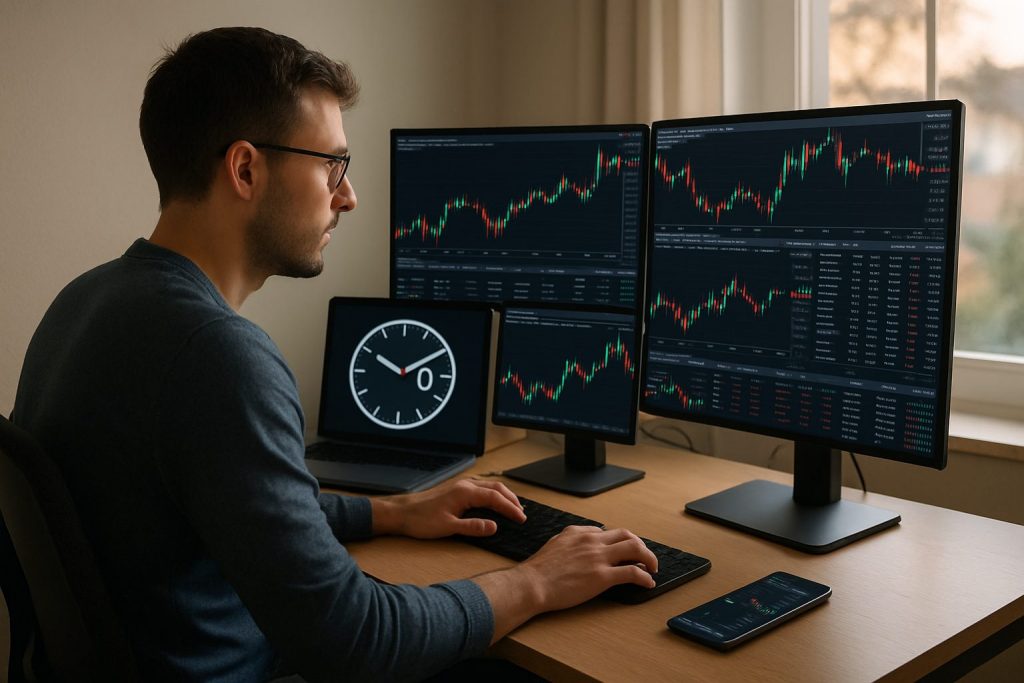
Yes — you can day trade only 1 hour a day, but success hinges on selecting the right market, using tight trading strategies, and maintaining strict trading discipline.
Compressing market activity into a single, focused hour is possible for a disciplined learner who prioritizes time management, rapid execution, and repeatable setups. The hour must capture peak liquidity or news-driven volatility — think the London/New York overlap for forex or the first hour of the stock market open for indices. Practical routines, demo-testing on platforms such as Pocket Option, and a single refined strategy such as scalping or a short breakout plan make the difference between sporadic wins and a replicable edge. This piece follows a part-time trader named Alex who uses a daily 60-minute block to scan, enter, manage and review trades. Expect fewer setups, higher sensitivity to single-trade outcomes, and the need for disciplined risk limits; but with consistent journaling and 30–60 demo sessions, the approach can become sustainable. Below are structured steps, tools, risk matrices, strategy choices and real numeric examples to turn one hour into a reliable trading routine.
Can You Day Trade Only 1 Hour a Day? Best markets and trading hours for short trading sessions
Choosing the right market and trading hours is the first decision. The goal is to place that hour where volatility and liquidity converge so setups occur regularly.
- Forex majors (EUR/USD) during the London/New York overlap for tight spreads and fast moves.
- Major indices around the opening hour for predictable volume surges and momentum.
- High-volume crypto pairs when volume spikes align with scheduled events or overlaps.
Alex prefers forex in his 60-minute block because spreads are low and markets run almost continuously, giving flexibility around his day job. Choosing the right hour directly reduces wasted scanning time and improves signal-to-noise ratio.
Key insight: map your single hour to known liquidity windows and stick to them so every session becomes comparable.
Practical steps and a timed routine to trade effectively in one hour
Turn a scattered hour into a repeatable process by splitting the session into preparation, execution and review. Use templates and pre-set orders to maximize the trading time.
- Pre-session (10–15 min): watchlist scan, economic calendar check, set price alerts.
- Setup (5 min): load saved chart layouts, place OCO/stop templates, confirm position size calculator.
- Execution (40 min): trade only on predefined signals, use hotkeys, limit the number of attempts.
- Post-session (10 min): log trades, screenshots, and update the journal.
| Step | Duration | Key Actions |
|---|---|---|
| Pre-session | 10–15 minutes | Watchlist, news filter, platform health check |
| Setup | 5 minutes | Load templates, pre-place stops and targets |
| Execution | 40 minutes | Enter trades only per rules, manage exits |
| Post-session | 10 minutes | Journal, screenshots, performance metrics |
Alex runs 30 demo sessions using the same hour and rules before going live on Pocket Option. He saved templates and uses alerts so the hour is for execution, not searching. This routine enforces trading discipline and removes decision friction.
Key insight: a timed routine converts limited time into consistent practice — treat the hour as a professional shift.
Tools, platform choice and setup for efficient short trading sessions
Select tools that remove friction: fast fills, hotkeys, saved layouts and reliable alerts. For beginners, platforms that offer low minimums and demo accounts accelerate learning.
- Use a platform with quick execution and demo features like Pocket Option to validate order templates and payout mechanics.
- Keep a minimalist watchlist (4–8 instruments) to reduce analysis paralysis.
- Install a stable charting tool, position size calculator, and an economic calendar with push notifications.
Platform recommendations and further reading include practical reviews and guides on starter capital, platform fit and whether day trading fits a full schedule: see articles on trading with a full-time job, broker limits for new accounts, and whether day trading is sustainable long-term.
Key insight: right tools reduce seconds lost — in a 60-minute session seconds are the edge.
Risk management and position sizing for one-hour day trading
With fewer trades, each loss has outsized influence. Protect capital by predefining risk and using stop-losses tied to volatility rather than arbitrary percentages.
- Risk per trade: start at 1% of capital; advanced beginners may consider up to 2% after demo validation.
- Daily loss cap: stop trading for the day after a 3%–5% drawdown.
- Maximum consecutive losses: set a hard stop after 2–3 losing trades in the hour.
| Account Size | Max Risk per Trade | Suggested Stop Basis |
|---|---|---|
| €500 | 1%–2% | ATR-based or key structure level |
| €1,000 | 1%–1.5% | ATR-based or technical support |
| €5,000+ | 1% | Tighter ATR or volatility-adjusted |
Alex stops after three losses and reviews trades to avoid emotional escalation. Conserving capital is the defining quality of long-term success in compressed sessions.
Key insight: when trading only an hour, winning the risk battle is the only way to keep showing up tomorrow.
Beginner-friendly trading strategies suited for a one-hour window
Pick strategies that produce clear signals and quick exits. Complexity hurts when time is limited; simple, rule-based approaches win.
- One-hour breakout on 5–15 minute charts: enter on confirmed break, ATR stop, 1.5–2 R target.
- Scalping momentum: 1–3 minute charts, strict stops, small targets — requires low spreads and fast execution.
- Moving average cross: EMA9/21 on 5-minute charts, volume confirmation.
- News-reaction fade: pre-define entry parameters around scheduled releases and trade the retracement with tight stops.
Test each strategy on demo for at least 30–60 sessions. For pragmatic reading on starting sizes and realistic returns, consult primers such as making returns with small capital and scaling from modest starting funds.
Key insight: simplicity and repetition beat complexity in short trading sessions; optimize one strategy for the hour and refine it relentlessly.
Numerical scenarios and platform considerations for short sessions
Two clear examples help illustrate outcomes: fixed-payout style trades and classic forex/CFD position sizing. Always demo-test payout mechanics on chosen platform.
- Fixed payout example: a €100 stake with 85% payout returns €185 on success; this structure requires different risk math because a single loss wipes the stake.
- Forex/CFD example: €1,000 account, 1% risk (€10), 20-pip stop, 40-pip target — position sized to lose €10 at stop and make €20 at target.
- Platform choice: start on Pocket Option demo to validate order templates and execution speed before risking capital.
For perspective on income expectations and career questions, see analyses like can you make €2,000 a week, and career viability pieces such as day trading to early retirement.
Key insight: build realistic scenarios on demo and scale only after consistent, recorded edge emerges.
Time management, psychology and the long view for one-hour traders
Successful short-session traders treat the hour like any other professional shift: preparation, execution, and review. Emotions must be pre-managed to prevent impulsive overtrading when opportunities are scarce.
- Use a pre-declared rule set to stop the session after loss limits or defined profit targets.
- Keep a concise journal: entry, thesis, outcome, and three takeaways per trade.
- Commit to a minimum demo sample (30–60 sessions) to build statistical confidence.
Alex frames the hour as work time; when not trading he avoids micro-managing and focuses on review and planning. This approach keeps trading consistent and sustainable.
Key insight: the psychological routine around the hour is as important as the technical setup — without it, repeatability collapses.
Alex’s checklist before each 60-minute session:
- Saved chart layouts and indicators (EMA9/21, RSI, Volume).
- Position size calculator set to 1% risk per trade.
- News filter active to avoid surprise releases.
- Demo-validated order templates on Pocket Option for practice.
Additional resources to explore: platform suitability, connectivity best practices, and whether students can build careers from compressed routines.
Can I day trade only 1 hour a day? — Answered briefly: Yes, with the right market, strict rules, and disciplined execution, one hour can be a practical and repeatable trading window.
Q: How many demo sessions before going live?
A: Aim for at least 30–60 consistent demo sessions using the same hour and rules to gather meaningful data on win rate and slippage.
Q: Which market is best for a single-hour routine?
A: Forex majors during overlap hours, major indices at open, or high-volume crypto pairs — pick one and master it.
Q: How much should be risked per trade?
A: Begin with 1% of capital per trade; increase only after consistent demo performance and tight risk rules are validated.
Q: Is Pocket Option a good starting platform?
A: Pocket Option is recommended for beginners because of its demo account, low minimum deposit and fast execution tools; always demo-test templates and payouts first.
Q: Can one-hour trading become a full-time career?
A: It can scale if consistent edge and capital growth are demonstrated; explore long-term viability in detailed analyses like is day trading sustainable long-term.

With over a decade of experience navigating global financial markets, I specialize in identifying trends and managing risk as a professional trader. My passion for economics drives my daily commitment to staying ahead in this fast-paced industry. Outside of the markets, I enjoy exploring technology like cryptocurrencies and new investment strategies.